The air coming from your car’s vents is warm, but that does not tell you which part has failed. Start by noticing how much air comes out and when the cooling changes. Weak airflow, warm air at idle and cooling that disappears soon after a regas point to different checks. None is a diagnosis by itself.
In short
- Strong airflow that stays warm calls for a cooling-system check. Weak airflow puts the cabin filter, blower and air path higher on the inspection list. DENSO’s air-conditioning service bulletin separates cooling performance from airflow and filter checks.
- Aircond that cools while moving but warms in traffic makes condenser airflow and fan operation worth checking. The driving pattern is a clue, not a verdict. DENSO’s service bulletin includes both checks in an A/C inspection.
- A regas changes the refrigerant charge but does not repair a leaking component. If cooling fades after a refill, ask for a leak assessment. DENSO’s A/C service bulletin includes leak testing before the final system check.
- You can check the dashboard settings and record the symptoms without opening the refrigerant circuit. The workshop should identify the fault before quoting a repair.
- Pungbrother’s published guide price for car air conditioning service is RM 150 for a small car or RM 200 for a large car, with an estimated workshop time of about 1.5 hours. These are estimates, not a compressor-replacement price or a promise that every repair is included. The firm quote comes before work starts. Pungbrother aircond service.
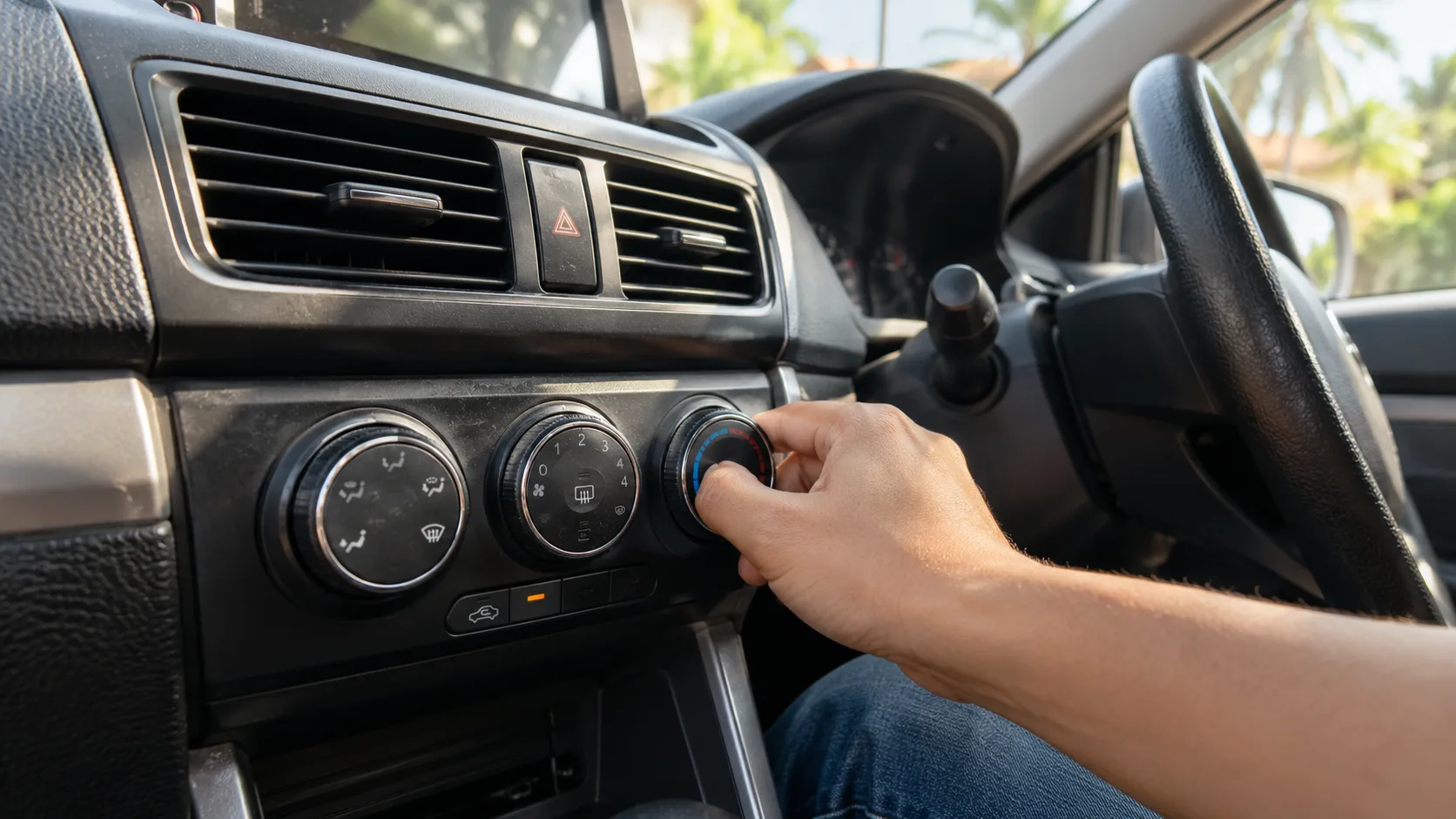
AI-generated illustrative image of cabin controls. This is not a Pungbrother vehicle or workshop photograph.
Which aircond symptom do you actually have?
Describe the symptom before asking for a part or a gas refill. A technician can use that pattern to decide what to inspect, but a car’s aircond cannot be diagnosed from a single sensation at the vent. DENSO’s service sequence begins by confirming performance and asking about noise, smell and the last maintenance; it later checks the filter, leaks, condenser, fan and air mixing.
| What you notice | What it suggests checking first | What it does not prove |
|---|---|---|
| Plenty of air, but it stays warm | A/C settings, cooling performance, refrigerant condition, compressor operation and air mixing | That the compressor must be replaced |
| Very little air, even at a high fan setting | Cabin filter, blower and restricted air path | That the system needs more refrigerant |
| Cold while driving, warm in slow traffic | Condenser airflow and fan operation, alongside system pressure | That the fan is definitely faulty |
| Cooling returns after a regas, then fades | A possible refrigerant leak and a reason to test rather than repeat a top-up | The location or size of a leak |
| New noise or smell when A/C starts | The timing and source of the symptom, then a targeted inspection | That one specific part is responsible |
The checks behind these patterns come from DENSO’s A/C service bulletin, which covers filter condition, leak testing, condenser airflow and fan operation. The table is a triage guide, not a remote diagnosis.
What can you check safely from the driver’s seat?
Before booking an aircond repair, check the controls in your own car’s manual. Control names and automatic modes differ by model. As one concrete example, Honda’s 2023 CR-V climate-control guide identifies separate A/C, fan, temperature and recirculation controls. It also explains that an economy mode can reduce cooling performance in that vehicle. Do not assume your car behaves in exactly the same way.
- Confirm that the A/C cooling function is on, not just the cabin fan. On an automatic climate system, check the selected temperature and any economy setting described in the vehicle manual.
- Set the fan to a clearly audible speed and feel the airflow at more than one vent. Is the air weak everywhere, or strong but warm?
- Note whether the air is cool at the start of a journey, only after the car is moving, or not at all. Tell the workshop if the symptom changes while idling in traffic.
- Record any new noise, unusual smell or rapid return of warm air after a previous regas. Those details are more useful than saying only that the aircond is broken.
- If the windscreen starts fogging, prioritise visibility and follow your vehicle’s defogging instructions. Recirculation can make windows fog more easily in some conditions, as Honda’s climate-control guide notes.
Do not open refrigerant lines, connect a refill can or put your hands near a running cooling fan to perform this check. DENSO’s service bulletin calls for identifying the correct refrigerant, checking for contamination and testing for leaks with suitable equipment. Those are workshop procedures, not dashboard checks.
Why is the air strong but still warm?
Strong vent airflow means the blower is moving air, but it does not tell you whether the refrigeration circuit is cooling it or whether the car is mixing it with warmer air. Possible inspection paths include refrigerant loss, condenser airflow, compressor control, electrical faults and air-mixing operation. DENSO includes condenser-fan operation and heating/cooling air mixing in its final system test. These different checks are why poor cooling does not automatically call for a regas.
Does warm air mean the compressor is broken?
No. A compressor problem is possible, but warm air alone does not identify it. The workshop must establish whether the system is requesting cooling, whether the compressor is operating as designed, what the pressure and refrigerant checks show, and whether heat is being rejected at the condenser. Replacing a compressor before those checks risks paying for a part that was not the cause. DENSO’s seven-step service procedure places performance, refrigerant, filter, leak and component checks before the final operation test.
Could low refrigerant be the cause?
It could. A low charge can reduce cooling, but the useful next question is why the charge is low and whether anything else is wrong. Adding refrigerant addresses the charge, not a leak in a hose or component. DENSO’s service bulletin calls for identifying refrigerant condition and checking for leakage as part of a proper A/C service. Ask what was measured and whether a leak test is indicated before accepting repeat top-ups as the whole repair plan.
Why is the aircond cold while driving but warm at idle?
Cooling that fades in traffic deserves a comparison under both conditions. The condenser relies on airflow to reject heat; when the car is not moving, fan operation matters more. DENSO’s service bulletin calls for checking dirt between the condenser and radiator, fan operation and the system’s cooling performance. This symptom should lead to those checks, not an instant fan replacement. Other A/C faults remain possible until the inspection is complete.
Dirt caught between the condenser and radiator can restrict airflow. DENSO explicitly includes inspection of that space and fan operation in its service bulletin. You can tell the workshop that the fault appears at a traffic light and disappears at speed; leave inspection around the fan and front cooling pack to a technician.
There is a useful exception: some cars suspend air-conditioning during an automatic engine stop while the blower keeps running. Honda’s 2023 CR-V guide describes exactly that behaviour for its auto idle-stop system. If the air warms only while the engine has stopped and cools as it restarts, check your own model’s manual before treating it as a fault. If the engine stays running and cooling still fades at idle, report that distinction to the workshop.
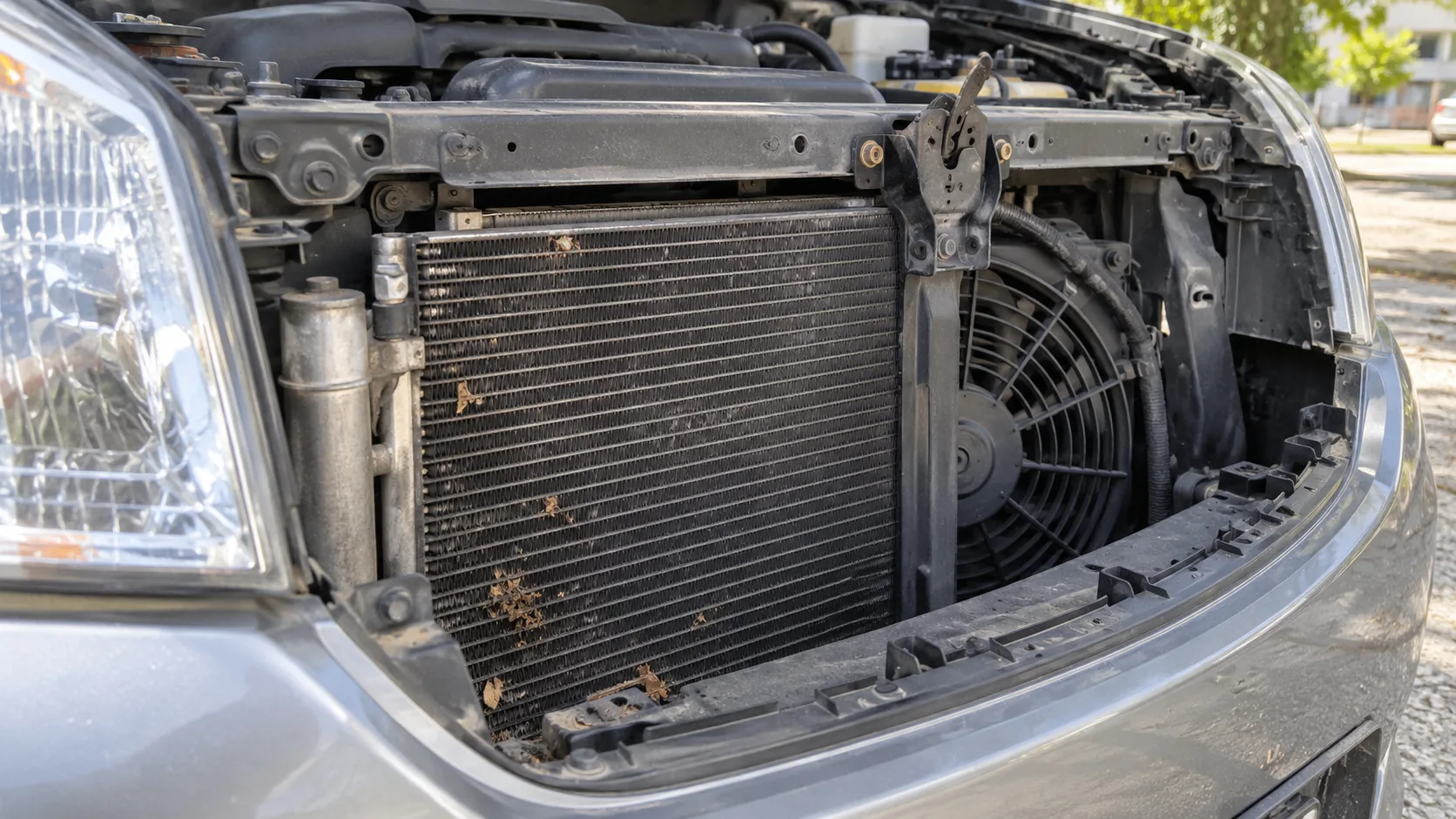
AI-generated illustrative image of a front cooling pack. It does not show a diagnosed fault or an actual Pungbrother repair.
Why is barely any air coming from the vents?
Weak airflow is a different complaint from strong, warm airflow. A clogged cabin filter may restrict air entering the cabin, while a blower or air-path problem can also reduce delivery. DENSO says that a neglected interior filter can substantially reduce airflow and includes a filter check early in its air-conditioning service sequence. Reduced airflow at the vent does not by itself establish a refrigerant problem.
If the fan makes noise but the flow is weak, note whether it happens at every speed and through every vent. That observation helps separate a general airflow restriction from a setting-specific complaint. Some cars make the cabin filter easy to inspect; others do not. Use the vehicle manual and do not force trim panels or assume that replacing a filter will fix a refrigeration fault.
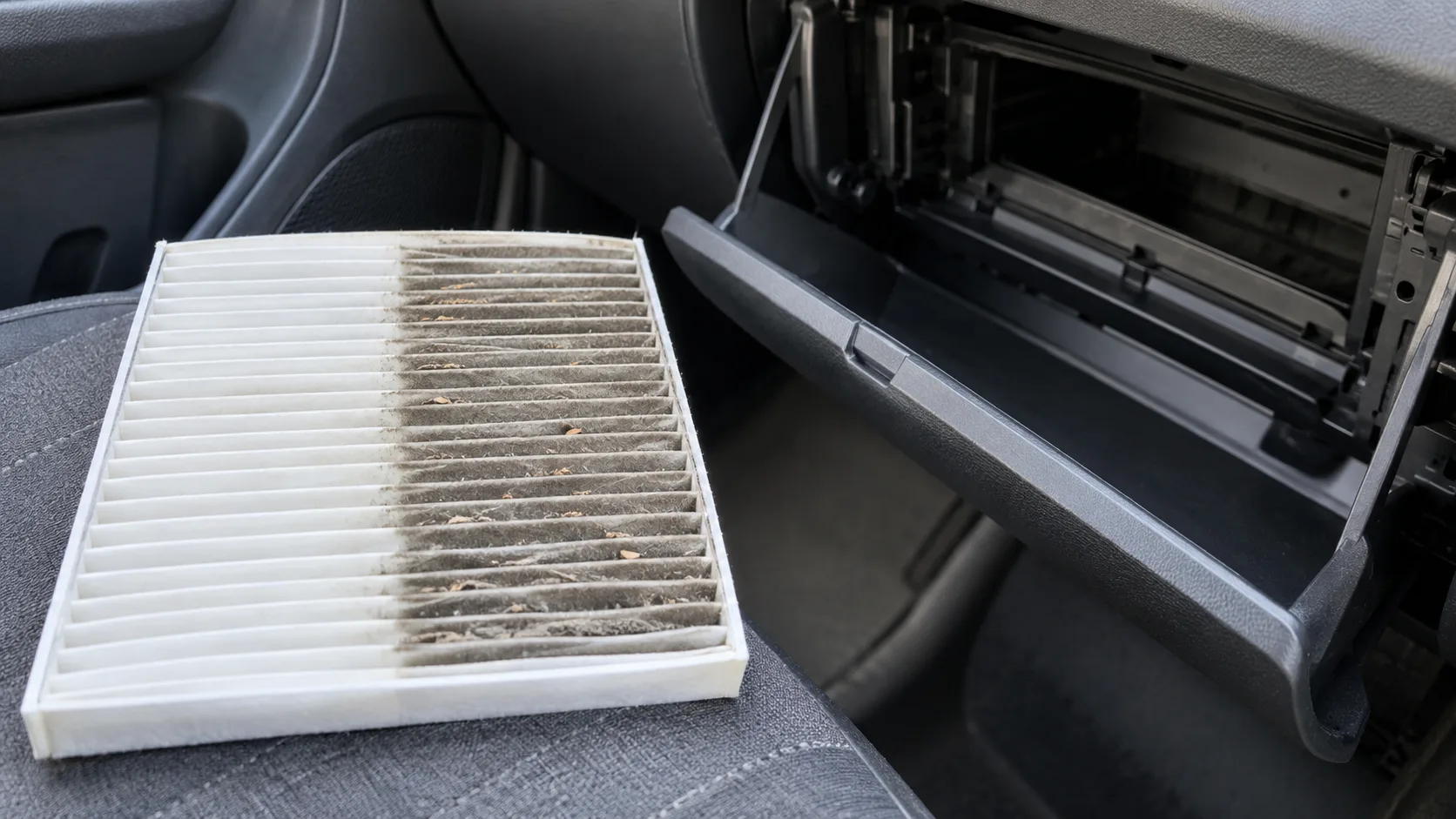
AI-generated illustrative image of a cabin filter. The pictured dirt pattern is not a diagnostic finding from a customer car.
Will an aircond regas fix the problem?
A regas is appropriate only when testing shows that the refrigerant charge needs correction and the rest of the system has been considered. It is not a universal cure for warm air, weak airflow, a non-working fan or a compressor-control fault. If cooling returns briefly and then disappears, request a leak assessment before paying for another top-up. DENSO’s service bulletin recommends combining leak-detection methods when needed and checking other A/C components before the final test.
The same logic applies to compressor replacement. A part should follow a diagnosis and a quote that states exactly what is being replaced, why, and what additional work is required. Pungbrother’s compressor-replacement service page lists no fixed guide price; the job is quoted after inspection. Do not treat the ordinary aircond service guide price as a compressor price.
What should an aircond inspection and quote cover in Masai?
Bring the workshop the symptoms and the vehicle details, then ask for the proposed checks before approving a repair. A useful conversation distinguishes inspection, refrigerant work and parts replacement. According to Pungbrother’s car aircond service page, its initial aircond service checks cooling performance, refrigerant pressure and visible signs of leakage. Any repair found necessary is quoted separately.
Pungbrother publishes guide prices of RM 150 for a small car and RM 200 for a large car for air conditioning service, with about 1.5 hours shown as the estimated workshop time. The published pricing page calls those figures estimates and says the firm quote is provided before work begins. The final amount depends on the actual vehicle and the agreed scope. No published guide price is available for compressor replacement.
Ask these questions before authorising work:
- Which symptom did the inspection reproduce, and under what conditions?
- Which checks have been done, and what finding supports the proposed repair?
- Is leak testing, refrigerant work, a filter, or a separate part included in this quote?
- If a part is proposed, which part is it and why would it solve the measured problem?
- What is the firm total before work starts?
You can send the model, year and symptom pattern through the Pungbrother contact page. The workshop address is 1, Jalan Kota 1/1, Cahaya Kota Puteri, 81750 Masai, Johor. Contacting the workshop does not substitute for an inspection.
Frequently asked questions
Why is my car aircond blowing warm air even with the fan on high?
Fan speed tells you how much air moves, not whether the air-conditioning circuit is cooling it. Confirm the A/C setting and describe whether the airflow is strong or weak; a workshop can then check cooling performance, refrigerant condition, condenser airflow and air mixing. DENSO’s service procedure covers those distinct checks.
Why does my car aircond get warm only in traffic?
At low road speed, the condenser depends more on fan-driven airflow, so a fan or airflow restriction is one possibility. DENSO calls for checking the condenser, fan and cooling performance together. The pattern is useful to report, but it does not diagnose a fan on its own. DENSO A/C service bulletin.
Can a dirty cabin filter make the aircond feel weak?
Yes, a restricted cabin filter can reduce the amount of air reaching the vents. It does not explain every warm-air complaint, especially when airflow remains strong. DENSO recommends checking whether the vehicle has an interior filter and whether it needs replacement. DENSO service bulletin.
Should I pay for an aircond gas top-up before a leak check?
Ask what the inspection has found first. A top-up may improve cooling, but it cannot permanently repair a leak, and repeated top-ups may postpone the actual fix. DENSO’s A/C service procedure includes leak testing and inspection of parts, hoses and connections.
Does an aircond service price include compressor replacement?
No. Pungbrother’s published guide price is for aircond service, not compressor replacement. The separate compressor-replacement page says replacement is quoted after inspection.
What details should I send before visiting the workshop?
Send the make, model and year, then describe whether the air is weak or strong, when it turns warm, and whether there is noise or smell. DENSO’s service sequence starts with the complaint and previous maintenance because those details guide the subsequent checks. They help the workshop prepare questions, but they cannot confirm a fault remotely.
The practical next step
Separate airflow from cooling and note when the symptom changes. Check the cabin controls, then describe the pattern rather than naming the part you think has failed. If cooling remains poor, ask for a measured inspection and a firm quote before any regas or replacement. A repeated gas top-up is not the same as fixing a leak.
Editorial status: test draft, not published. Technical advice and the three AI-generated illustrations require a qualified automotive review before release. The illustrations are explanatory only; none depicts Pungbrother’s premises, staff or customer vehicles.