There is no guaranteed battery lifespan for every car in Malaysia. A battery’s condition depends on its design, heat exposure, driving pattern, charging system and maintenance. Battery maker Interstate gives a broad three-to-five-year estimate for typical car batteries, but that is not a Malaysian warranty or replacement deadline. Test a suspect battery rather than replacing it from age alone.
In short
- Battery age is a reason to pay attention, not proof of failure. Performance testing is more useful than a calendar estimate.
- Heat, repeated short trips and long periods parked can affect a 12-volt battery. Interstate discusses these factors in its general lifespan guidance.
- Slow cranking, repeated jump starts and unreliable starts justify an inspection, but the battery may not be the only cause.
- Ask for a battery and charging-system assessment before buying a replacement. DENSO’s diagnostic guidance includes terminals, connections and charging components.
- Pungbrother’s battery replacement has published estimates of RM250 for a small car and RM350 for a large car, subject to a firm quote.
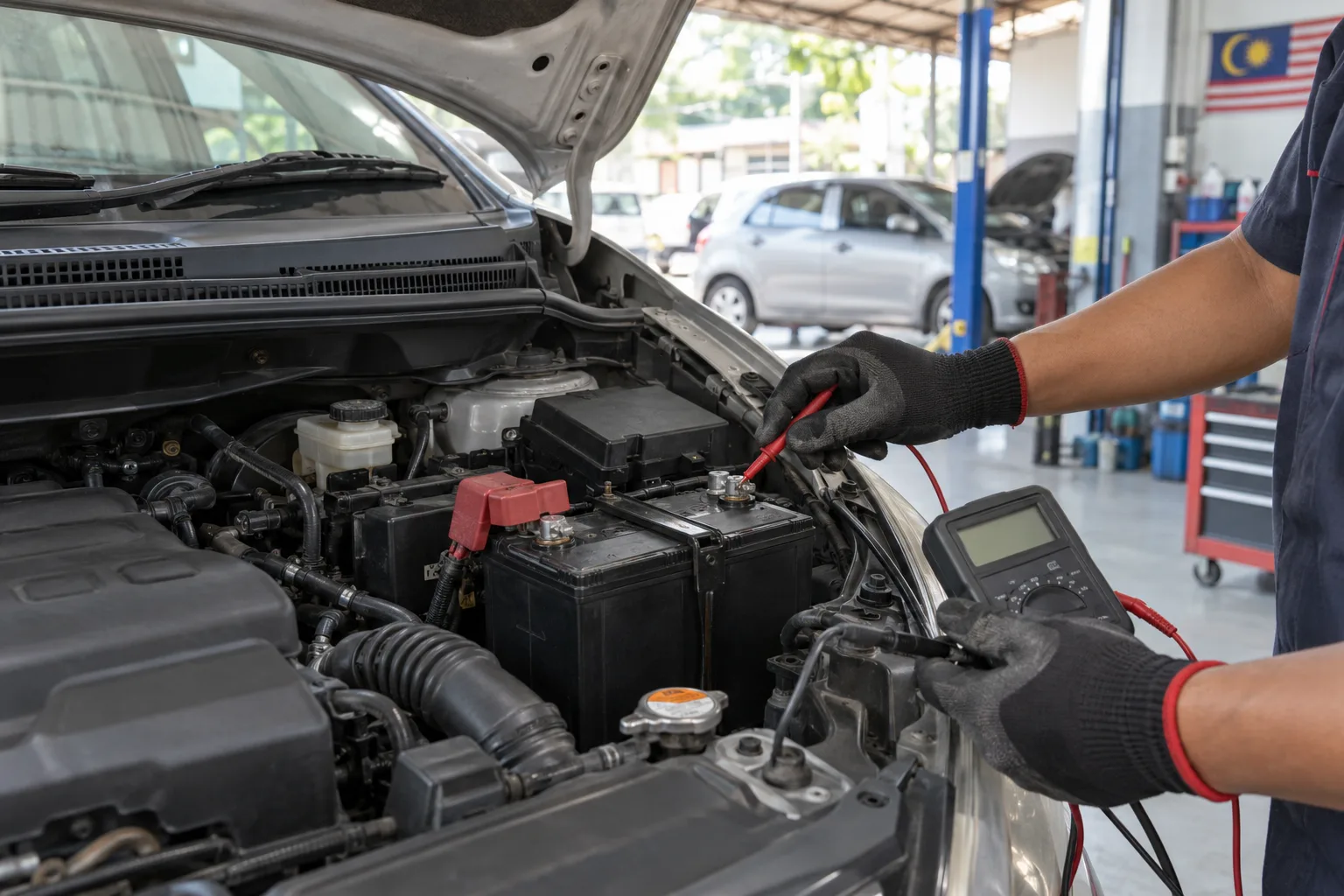
AI-generated illustration. The meter does not display a real test result.
Why is there no one battery lifespan for Malaysia?
A 12-volt starter battery is affected by the car’s electrical demand, starting frequency, charge received during driving and conditions where it is parked. High heat can accelerate ageing, while frequent short drives may not replenish the energy used to start the engine. Interstate’s battery-life article gives a broad three-to-five-year range and notes that climate and driving habits matter. It is a broad manufacturer’s explanation, not a prediction for a particular battery in Masai.
Many Malaysian drivers hear a shorter rule of thumb, but a local-sounding number without a test is still only a guess. One battery may struggle early because of a charging fault, heavy parasitic draw or poor connections; another may continue to meet its car’s needs longer than expected. Vehicle type matters too. This guide addresses the conventional 12-volt battery used for starting and accessories, not a hybrid or electric vehicle high-voltage traction battery. Those systems require different procedures and safety precautions.
The practical question is not “Is my battery exactly two years old?” but “Can it reliably perform the job the vehicle requires?” A workshop can check battery condition in context and investigate why a replacement might fail prematurely. Otherwise, a new battery fitted onto a faulty charging system can produce the same complaint later.
Which signs suggest the battery needs testing?
The familiar clue is slow or laboured cranking when starting. You may also notice an intermittent no-start, repeated need for a jump start or accessories behaving differently before the engine starts. These symptoms justify testing, but none proves that the battery itself is bad. Corroded or loose connections, a starter fault and an alternator or charging problem may overlap. DENSO’s charging-system diagnosis guide begins with checking battery condition and connections as part of the wider system.
Record when the weak start happens. Is it after the car has sat overnight, after several days parked, or immediately after a long drive? Was any light left on? Does the engine crank slowly or not crank at all? Does the dashboard show a battery-shaped warning while the engine is running? That last warning may point to a charging-system problem and can require a different, more urgent response under the owner’s manual. Do not use it as a simple “replace the battery” indicator.
If you are stranded, follow the vehicle maker’s safe-starting instructions and ask for roadside assistance if needed. Do not repeatedly try to start an engine until electrical components overheat or improvise a jump start on a hybrid or unfamiliar system. Our dead battery guide covers the immediate no-start decision separately from long-term battery health.
Can you judge battery condition by voltage or appearance alone?
Not reliably. A voltage reading can tell part of the story, but battery state of charge and actual performance under load are different questions. Interstate’s battery-testing guidance describes the value of a proper test. A battery may look clean and still lack starting capacity; a low reading may reflect recent discharge rather than an irrecoverable battery. The charging system must also be considered.
Visual condition still matters. A technician should check that the case and terminals are appropriate and connections are secure. Corrosion or loose clamps can affect starting and charging. Do not scrape or disconnect terminals without knowing the vehicle procedure; some vehicles have electronic settings or safety requirements, and battery acid is hazardous. If the case is damaged, leaking or swollen, seek qualified advice and keep clear of it.
Ask the workshop what was tested: state of charge, performance, charging output or connection condition. A vague statement that “battery weak” tells you less than the actual finding. If a replacement is recommended, ask whether the charging system was checked and whether the correct battery specification for your vehicle has been confirmed.
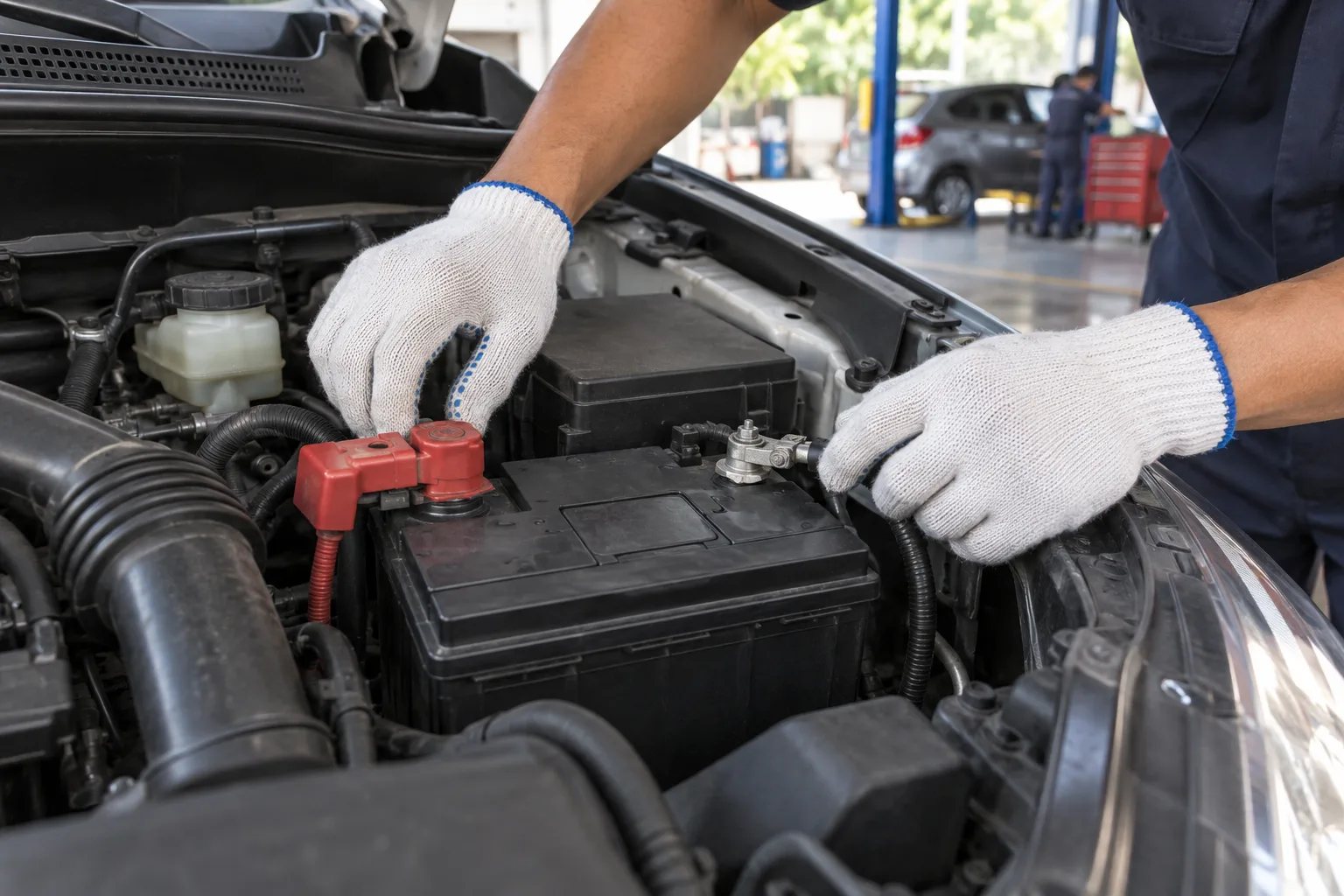
AI-generated illustration. Do not use it to diagnose the condition of your own terminals.
How do short trips and long parking periods affect a battery?
Starting uses stored electrical energy. The car normally replenishes it while the engine runs and the charging system works, but repeated short trips can reduce the opportunity to recharge fully. Long parking periods can also let a battery discharge. Interstate’s guidance on a sitting car explains why infrequent use warrants attention. The effect on any one car depends on the battery, electrical loads and time parked.
If a car is rarely used, follow the manufacturer’s battery-care advice and ask a qualified workshop whether a suitable maintenance charger is appropriate. Do not leave a generic charger connected to an unfamiliar vehicle or battery type. If the vehicle is used regularly but still goes flat after parking overnight, testing should cover the battery, charging system and possible electrical drain. Buying successive batteries without diagnosing the cause is not an effective plan.
Heat exposure matters too. A car parked outside in a hot climate may experience different battery conditions from one garaged under shade. But you cannot tell whether a particular battery is healthy merely from where it was parked. A test before a long drive is more actionable than arguing over a theoretical lifespan number.
| Situation | What it may suggest | What to ask for |
|---|---|---|
| Slow crank after overnight parking | Battery charge, connections or starting system | Battery and connection test |
| Flat after several parked days | Battery condition or electrical drain | Test with parking history |
| Weak start after a long drive | Charging, battery or connection problem | Battery plus charging-system check |
| Battery-shaped lamp while running | Possible charging-system fault | Follow owner manual, seek urgent advice |
| Battery older than expected range | Age-related risk, not proven failure | Performance test before replacement |
When should you replace rather than recharge the battery?
Replacement makes sense when a proper test and the vehicle’s requirements show the battery can no longer perform adequately, or when the case is damaged and the battery is unsafe. A discharged but otherwise serviceable battery may need charging and investigation of why it became low. The distinction matters because recharging a failed battery does not restore lost capacity, while replacing a healthy battery does not fix a parasitic draw or alternator fault.
Ask about the battery’s warranty, correct size, terminal layout and electrical specification for your model. Some vehicles need specific battery technology or a registration procedure after replacement. Do not choose solely by a price list or a photo. If a workshop recommends a larger or different battery, request the reason and compatibility confirmation from the vehicle and battery maker’s information.
Pungbrother’s battery replacement service is a possible next step after a confirmed finding. Its pricing page lists RM250 for small cars and RM350 for large cars, with approximately 30 minutes shown for the listed service. These are estimates; the actual battery specification and firm quote must be confirmed before work. The published price does not prove that every model or battery type is covered at that amount.
What should you ask Pungbrother in Masai?
Tell the workshop the vehicle model and year, battery age if known, starting symptom, parking pattern, any jump starts and whether the charging warning appeared. Ask whether the battery will be performance-tested and whether terminals and charging output need checking. If you have an earlier test report, bring it. A clear history helps distinguish a one-time discharge from a recurring fault.
Pungbrother Enterprise is at 1, Jalan Kota 1/1, Cahaya Kota Puteri, 81750 Masai, Johor. Use the Masai workshop contact details for the current phone and opening hours. If the car will not start or shows a charging warning while driving, ask for advice on safe transport; do not assume the workshop offers a mobile battery service or that continued driving is safe.
After testing, request the result, the correct replacement specification if one is needed, and the firm quote. If the battery passes but the symptom remains, ask what the next diagnostic step is. That is a more useful outcome than replacing a battery because it crossed a rough age threshold.
AI-generated illustration. It does not represent an actual Pungbrother customer or vehicle.
Frequently asked questions
Is a car battery guaranteed to last three to five years?
No. Interstate gives that as a broad typical range, not a Malaysian guarantee. Heat, use and charging condition vary. Test the battery when symptoms appear or before a demanding trip.
Does hot Malaysian weather shorten battery life?
Heat can contribute to battery ageing, according to Interstate’s guidance. It cannot predict the exact remaining life of an individual battery, so testing remains important.
Will a new battery fix slow starting?
Only if the battery is the cause. Poor connections, charging faults and starting-system issues can also slow a start. Ask for diagnosis before approving replacement.
Is a battery-shaped warning light proof that the battery is bad?
No. It may indicate a charging-system problem while the engine runs. Follow the vehicle manual, stop safely when directed and have the battery and charging system checked.
Can a healthy battery go flat if the car sits unused?
Yes, batteries discharge over time and vehicle electrical systems may draw power while parked. If discharge seems unusual or recurring, ask for testing rather than guessing.
What is Pungbrother’s published battery replacement estimate?
The pricing page lists RM250 for small cars and RM350 for large cars. Confirm the correct battery and a firm quote before work.