If the car is parked and will not start, you may suspect a dead battery. First make sure you and the vehicle are in a safe place. Then note what happens when you attempt a normal start. A quiet dashboard, clicking, or slow engine cranking can make the battery worth testing, but none of those signs proves that the battery itself has failed. You can arrange help without opening the bonnet or attempting an unfamiliar jump start.
In short
- Prioritise your location and personal safety. If the car is beside moving traffic or the battery looks damaged, do not begin an improvised roadside repair.
- A battery may be discharged, deteriorated or unable to start the engine because of a poor connection. DENSO’s starter troubleshooting includes battery, cable and starter-circuit causes for no-crank and slow-crank complaints.
- Use the owner’s manual for the exact vehicle before any jump start. The connection points and precautions are not identical across cars; Toyota’s manual for a 2024 Grand Highlander Hybrid gives a model-specific jump terminal, illustrating why a generic diagram is not enough.
- A successful jump start is temporary evidence that outside power helped. It is not a battery-health test and does not rule out a charging or connection problem. DENSO’s charging-system guidance calls for battery and cable checks before judging the alternator.
- Pungbrother lists car battery replacement at an estimated RM 250 for a small car or RM 350 for a large car. Its page says battery condition and charging voltage are checked before fitting a replacement. The final quote is confirmed before work, and the price is not a diagnosis.
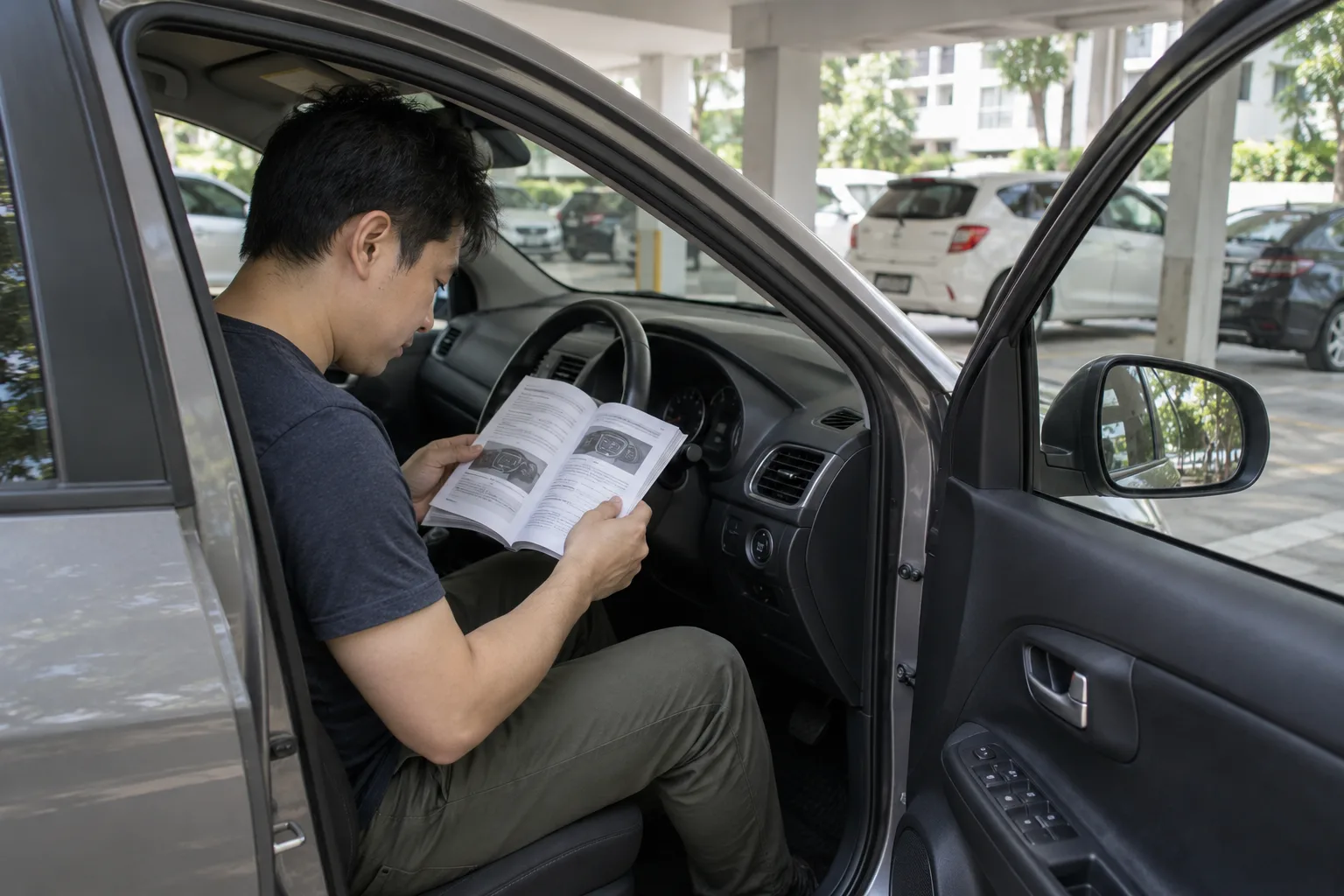
AI-generated illustration. The driver and vehicle are not Pungbrother staff or a customer, and the manual is not a reproduced manufacturer document.
Is the car safe to approach and inspect?
Location comes before troubleshooting. If the car is stopped in a live lane, on a narrow shoulder or somewhere you cannot safely stand, move clear of traffic when possible and request appropriate assistance. Do not work under an open bonnet with traffic passing close by. If the vehicle is in a parking bay, set the parking brake and make sure it cannot roll. Follow the owner’s manual and local roadside instructions for your situation.
Do not touch the battery if its case looks cracked, swollen or wet, or if you notice a strong unusual smell, smoke or heat. A car battery can present acid, electrical and fire hazards. Toyota’s battery safety guide says handling it incorrectly can cause injury or damage to the vehicle and regards a trained technician as the safest choice for replacement. It also directs owners to their own manual for vehicle-specific precautions. Although that Toyota page is written for US-market cars, those general cautions justify seeking qualified help, not assuming a Toyota procedure applies to a Malaysian vehicle.
If you cannot safely inspect the car, you still have useful information to give a workshop: where it is, the model and year, what happened during the last normal journey, whether any warning light appeared, and the response to one ordinary start attempt. Do not keep cranking over and over to gather more clues. Write down the exact sound and dashboard behaviour while you can remember them.
Is the battery definitely dead?
No symptom alone proves it. A quiet or slow start can point toward a low battery, but a poor terminal connection or a starting-system fault can look similar. DENSO’s starting-system chart lists a dead battery, loose connections, start-switch problems and starter faults among possible explanations when the engine does not crank. For slow cranking it lists a weak battery, loose or corroded connections and starter faults. A proper test separates these possibilities more reliably than the age of the battery or a dashboard impression.
Use this table only to describe the complaint, not to select a replacement part:
| What you notice | What to tell the workshop | What remains unknown |
|---|---|---|
| Dashboard is dark and engine does not turn | Which lights or displays respond, and whether it happened suddenly | Battery charge, cable condition and other electrical causes |
| One click or repeated clicks, no engine rotation | Number and timing of clicks, plus whether the lights change | Whether the supply, connection or starter circuit is responsible |
| Engine turns unusually slowly | Whether slow cranking appeared after parking or on every start | Battery condition and resistance in the starting circuit |
| Engine turns normally but does not run | That it cranks normally but will not start | Whether this is a separate engine-control or fuel-related problem |
| Car starts with outside help, then fails again | How long it ran and when the next failed start occurred | Battery health, charging performance and possible drain |
The DENSO starter guide supports the no-crank and slow-crank distinctions. The other rows are prompts for a clear history, not fault diagnoses. If the engine turns normally but never begins to run, the problem may not be a dead battery at all. Tell the workshop that the engine cranks but does not start, so it can choose the appropriate diagnostic path.
What can you check without touching the battery?
Start with observations available from the driver’s seat. Confirm the gear selector and start procedure required by your owner’s manual. Some cars require the brake or clutch pedal to be pressed; keyless systems may have a model-specific method if the remote battery is weak. Do not assume that advice for a different vehicle applies to yours.
Then note the following, without trying to diagnose from any one item:
- Does the instrument cluster light up as it normally does before starting?
- Do the headlamps or cabin lights appear unusually dim, or change sharply during a normal start attempt?
- Is there silence, a click, slow cranking or normal cranking without the engine running?
- Was a charging warning light on during the previous drive?
- Was the vehicle parked for an unusually long period, or was an electrical accessory left on?
These observations help the technician decide which test to begin with. They do not tell you to buy a battery. DENSO’s battery inspection and performance-test guide treats visual condition, state of charge and performance as separate checks. It also says the vehicle manufacturer’s service manual should govern the specific procedure and safety precautions.
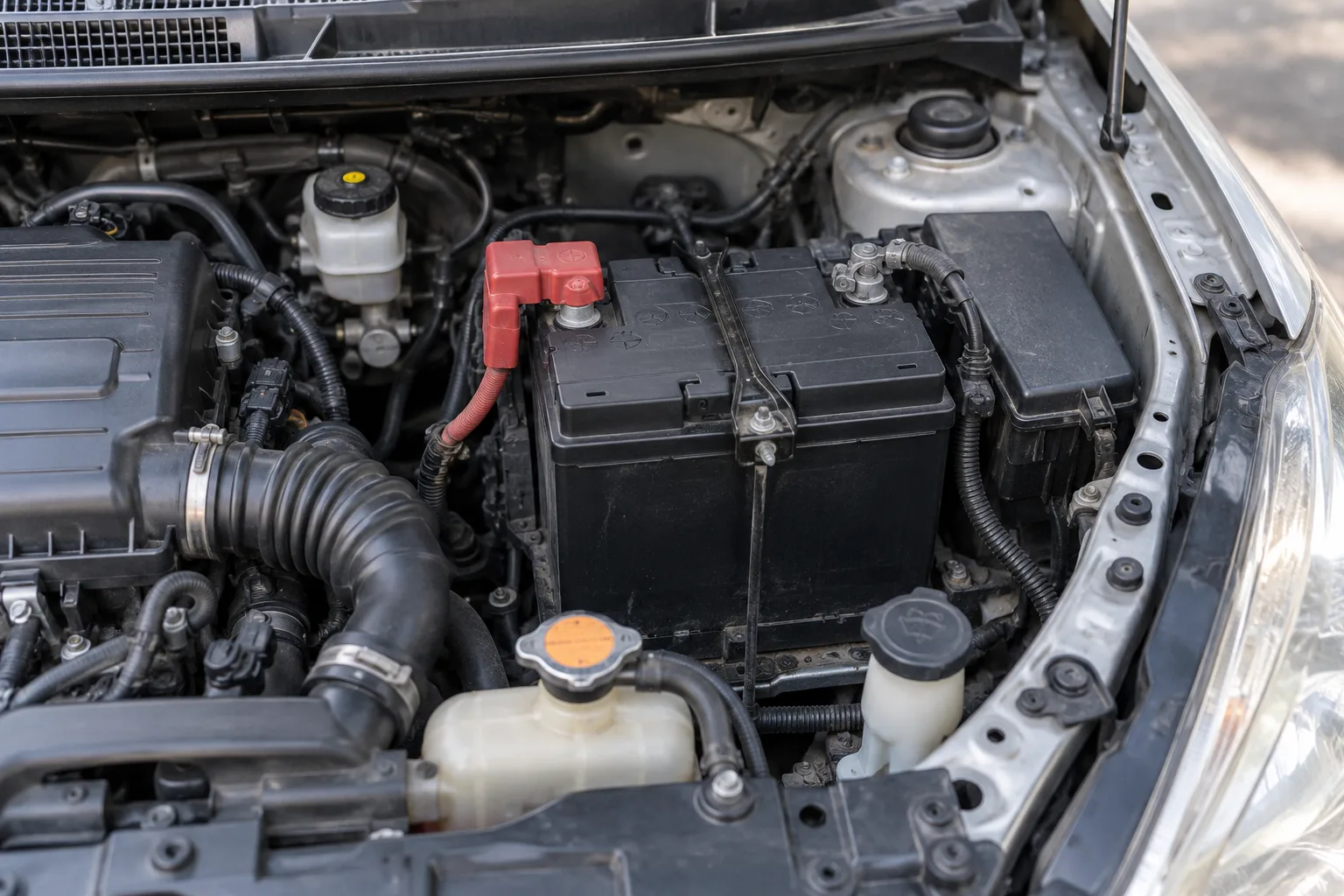
AI-generated illustration of a generic engine bay. It does not show a diagnosed fault or a Pungbrother repair.
Should you jump-start the car?
Only if the vehicle manual permits it, the battery and location are safe, the equipment is suitable, and you understand the exact procedure. If any of those conditions is uncertain, ask for qualified assistance. A jump start is not a universal four-clamp recipe: some vehicles provide dedicated jump terminals and specify a particular grounding point. The 2024 Toyota Grand Highlander Hybrid manual is one concrete example of model-specific instructions. That manual is not an instruction for your car.
Do not attempt a jump start with a cracked, leaking, visibly damaged or unusually hot battery. Keep any equipment clear of belts and fans. If you are unfamiliar with the procedure, use the exact owner’s manual or a competent technician rather than copying a diagram for another car. Toyota’s battery guide warns that incorrect battery handling can injure people or damage electrical systems. The article planned specifically for jump-start procedure will require separate technical review before publication, so this page deliberately stops at the decision point.
If the engine starts with assistance, do not conclude that the battery needs replacing, or that a drive will permanently fix the issue. A battery can be deeply discharged, unable to hold charge, or affected by a connection or charging fault. DENSO’s charging-system diagnosis begins with battery and connection condition before assessing charging performance. The safe follow-up is to arrange a check and mention that outside power was needed.
Can you drive after an assisted start?
That depends on why the car failed and what the dashboard shows afterward. If the charging warning remains on, the engine runs abnormally, you smell burning, or the car seems unsafe to drive, do not assume it will make it to the workshop. Consult the owner’s manual and arrange suitable assistance. If the car runs normally and the manual gives no warning, ask the workshop what the safest way to bring it in is. This article cannot assess your exact vehicle at the roadside.
A successful start may feel like a repair, but it only changes the immediate symptom. DENSO’s charging-system guidance treats the battery, cables, charge lamp, belt and wiring as parts of a systematic diagnosis. It also notes that warning-lamp behaviour can reflect several faults. The garage needs the sequence of events: whether the lamp was on before the battery became flat, whether the failure happened again after driving, and whether electrical accessories behaved unusually.
If the engine stalls while driving, or will not restart after stopping, share that detail. It helps distinguish an isolated parking-lot no-start from a possible charging or other running fault. Do not make a long journey solely to “charge the battery” without knowing the cause, especially when a warning light remains on. The owner manual may prescribe a different response for your model.
What battery checks matter before replacement?
The workshop should establish whether the battery is physically sound, charged enough to test and capable of supplying starting power for the vehicle. DENSO’s battery guide describes visual checks of the case, posts, cable condition, security and corrosion before a performance test. It also says the correct battery type and fit depend on manufacturer specifications. A battery that fits the tray is not automatically the correct specification for the car.
Ask whether the test found a discharged battery, a battery that failed a performance test, or a good battery with a connection or charging problem. That distinction should be clear in the quote. If a battery is replaced, the charging system still deserves attention when the history suggests it may not have been replenishing the old battery. Pungbrother’s battery replacement page says it checks battery condition and charging voltage before fitting a replacement. That published scope does not mean every possible electrical fault is included in a battery price.
Do not disconnect terminals or clean corrosion as a casual roadside experiment. Batteries can release hazardous gas, and disturbing electrical connections may affect vehicle systems. Toyota’s owner-facing safety advice recommends technician replacement as the safest option. If you choose to work on your own car, the precise manual and appropriate protective equipment matter; this guide is not an installation procedure.
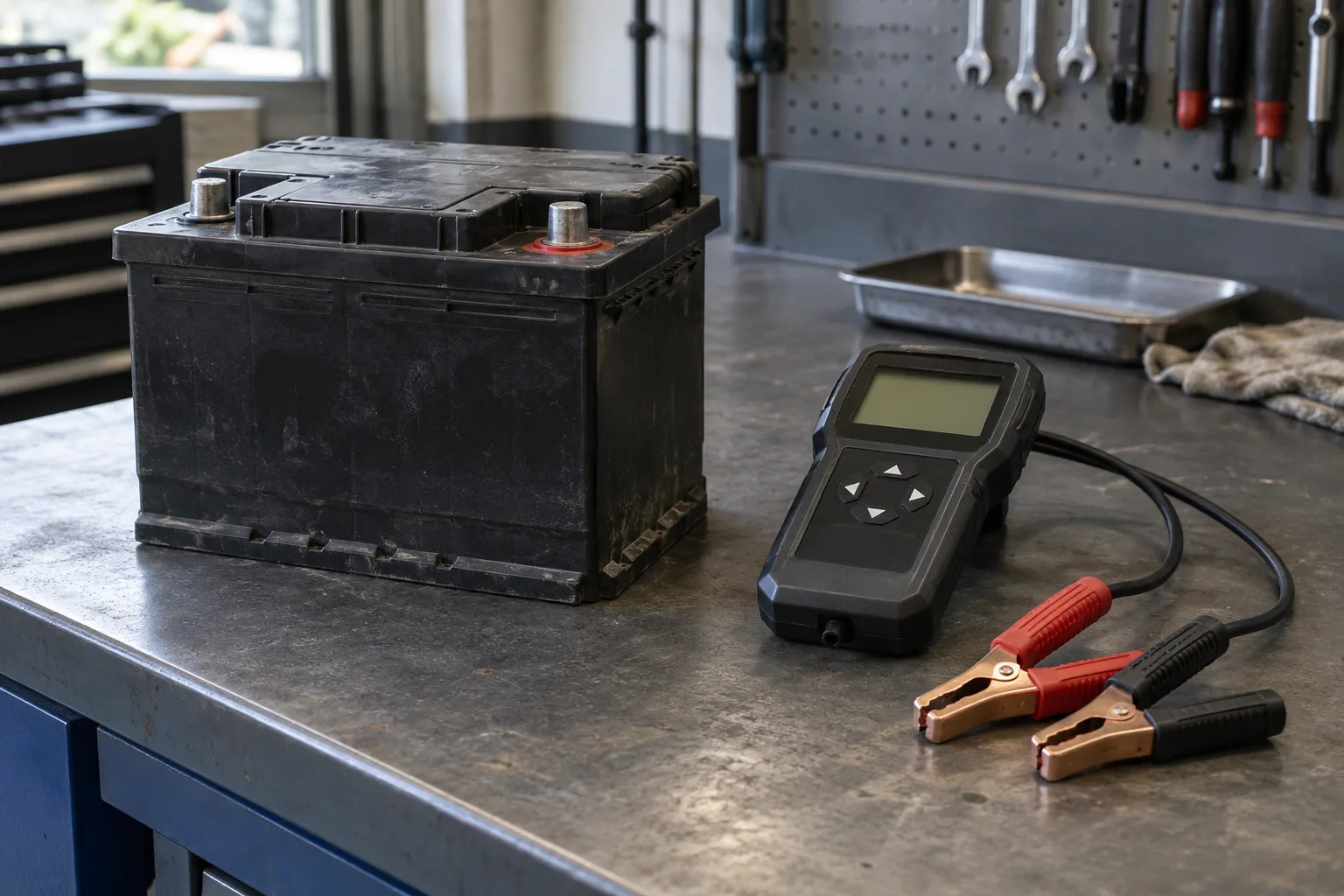
AI-generated workshop illustration. The tester has no displayed result; this is not evidence that a real battery passed or failed a test.
How much does an inspection or replacement cost in Masai?
Pungbrother Enterprise publishes an estimated RM 250 for a small car and RM 350 for a large car for car battery replacement. Its page lists a typical workshop duration of about 30 minutes and says battery and charging checks precede fitting. The workshop’s pricing page says these are guide prices and that a firm quote is provided for approval before work starts. They are not a promise that the battery is the problem or that every electrical repair is included.
For a broader no-start complaint, car diagnostic inspection has a published guide price of RM 80 for a small car or RM 120 for a large car, with about one hour shown as the typical duration. Repair work follows the findings and an agreed quote. The site does not list a fixed price for every alternator or starter repair; the alternator and starter service is quoted after inspection. If the car is stranded, ask what practical assistance is available instead of assuming mobile battery delivery or towing is offered.
When contacting the workshop, provide the model and year, your location, the start symptom, any warning light, whether a jump start was attempted and whether the engine ran afterward. Keep the owner’s manual handy if it identifies special battery or jump-point instructions. The phone and WhatsApp contact page lists Pungbrother’s current phone and WhatsApp details for a direct conversation.
Questions drivers often ask
Does a flat battery always need replacing?
No. A discharged battery may be recoverable, while a deteriorated battery may fail a performance test. The underlying reason it lost charge also matters. DENSO’s battery guidance separates condition, charge and performance testing; a workshop can explain which result supports replacement.
Can the lights work even if the car will not start?
Yes. Lights and the starter do not place the same demand on the electrical system. Working lights do not prove that the battery, connections or starter circuit are healthy. Tell the workshop how the lights behave during a normal start attempt and request the relevant tests rather than buying a part from that observation alone.
Is it safe to jump-start any car?
No. The exact vehicle manual, battery condition, equipment and location all matter. Toyota’s Grand Highlander Hybrid manual demonstrates that some cars have dedicated jump points. If you do not have the correct model instructions or a safe place to work, arrange qualified help.
Does a successful jump start prove the battery is bad?
No. It only shows that outside power helped start the car at that moment. The battery may be discharged or deteriorated, but poor connections or charging issues can also play a part. DENSO’s charging-system guide calls for battery and cable checks before reaching a charging-system conclusion.
Should I replace the battery myself?
Do not treat it as a risk-free swap. The correct battery specification, safe handling and vehicle-specific procedures all matter. Toyota’s safety guidance says trained technician replacement is the safest course and directs owners to their vehicle manual if they proceed themselves.
What should I tell Pungbrother when I call?
Give the vehicle model and year, the exact no-start behaviour, your location, any warning messages and what happened after any assisted start. Say if the car cannot be moved safely. Pungbrother’s phone and WhatsApp contact page provides its phone and WhatsApp details; the workshop can advise what it can inspect or arrange after hearing the circumstances.
The next step
Treat a suspected dead battery as a reason to document symptoms and seek a proper check, not as a reason to purchase the first battery that fits. Stay safe, consult the correct owner’s manual before any jump start, and ask the workshop to distinguish discharge, battery failure, connection trouble and charging trouble. If you are in the Masai area, contact Pungbrother with the vehicle details and ask for the appropriate inspection and a firm quote before work.