The battery, alternator and starter do different jobs, but their failures can produce similar complaints. The battery supplies power for a start attempt, the starter turns the engine, and the charging system replenishes electrical power while the engine runs. A symptom alone rarely identifies the failed part. A sensible diagnosis starts with what the car does, checks the battery and connections, then tests the relevant starting or charging circuit.
In short
- No crank or slow crank can involve the battery, its cables, the starter or the control circuit. DENSO’s starter troubleshooting names several possibilities.
- A charging warning while the engine runs raises a charging-system question, but does not prove the alternator itself is defective. DENSO’s charging guide checks battery and connections first.
- A successful jump start shows that external power helped the start. It is not a parts-ordering test.
- A battery that tests adequately does not rule out poor connections or a starter-circuit problem.
- Ask the workshop for the test result that connects the observed symptom to the proposed repair.
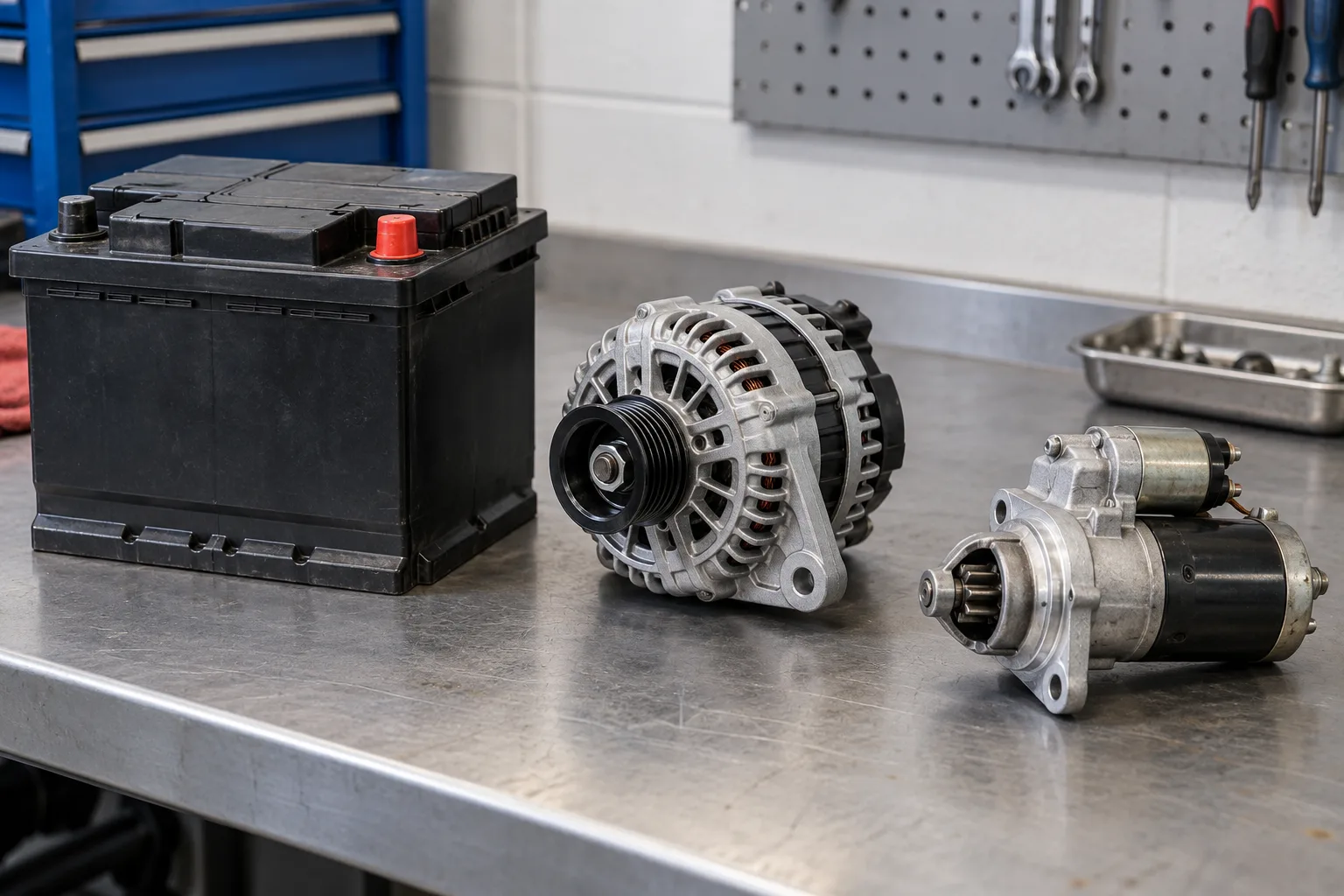
AI-generated illustration of three component types. It is not a Pungbrother repair or a diagram for your particular car.
What does each part do at the moment of starting?
The 12-volt battery provides electrical power before the engine is running. The starter motor and its control circuit use that power to turn the engine. After the engine runs, the charging system supplies electrical demand and replenishes the battery as designed by the vehicle maker. This sequence explains why a car that does not crank and a car that stalls after a charging warning need different first questions. It also explains why replacing a battery may appear to help briefly when the underlying charging problem remains.
Modern vehicles can place battery, starter and charging components in different positions or use different control strategies. Hybrid vehicles add another layer: a high-voltage traction battery is not the same thing as the 12-volt system discussed here. The relevant owner and service manuals determine safe tests. Toyota’s Grand Highlander Hybrid 12-volt manual is one example of a dedicated jump terminal, not a procedure for every hybrid.
The driver does not need to identify every wire. A useful observation is whether the engine turns at all and whether the car had warning lights or electrical problems before it stopped. A technician can then follow the manufacturer’s test sequence rather than guessing from a single sound.
Which symptom points where, and where can it mislead?
Use the following as a conversation guide. It is not a diagnostic verdict.
| What happens | System to investigate first | Why the symptom is not conclusive |
|---|---|---|
| Engine does not turn; dashboard is weak or dark | Battery supply and connections | Battery, cable, ground or control issues may overlap |
| A click occurs, but the engine does not turn | Starting supply and starter circuit | A weak supply and a faulty starter can sound similar |
| Engine turns more slowly than usual | Battery, cables and starter | Slow cranking has several electrical causes |
| Engine starts after a jump, then later fails again | Battery condition and charging performance | The first jump does not identify the cause of discharge |
| Charging warning appears while driving | Charging system and its circuits | The lamp is not an alternator replacement order |
| Engine turns normally but will not run | Other engine-management causes as appropriate | Battery and starter have already turned the engine |
DENSO’s starter diagnostic chart separates no-crank and slow-crank complaints and lists tests for battery, cables and starting circuitry. Its charging-system diagnosis stresses checking the battery and connections before judging alternator output. These manufacturer-side sequences support a tested decision, not a symptom-to-part shortcut.
When is the battery a reasonable suspect?
A battery deserves testing when cranking becomes slow, starting becomes intermittent after the car sits, or the car repeatedly needs external power. It may be discharged but otherwise serviceable, or it may no longer meet the vehicle’s performance requirement. These are different findings. The workshop should inspect the case, mounting, terminals and cables before interpreting a battery performance test. DENSO’s battery inspection guide describes that order.
Battery age can be context, but not a pass-or-fail test. A recent battery may be discharged by a charging or electrical problem. An older battery may still test adequately for the car’s specification. Avoid assuming a generic lifespan in Malaysian weather settles the case. If a battery case is cracked or leaking, do not touch it or attempt a jump. Toyota’s battery guidance explains the physical and electrical hazards of battery handling.
Ask what the battery test actually showed, and whether it was charged sufficiently to be tested fairly. If the workshop recommends replacement, confirm the correct specification for your model and whether another fault caused the discharge. A new battery fitted into an unresolved charging or drain problem can leave you with the same complaint soon afterward.
When should the alternator or charging system be tested?
If a charging warning appeared while the engine was running, lights or accessories behaved abnormally on the road, or a charged battery quickly becomes weak again, charging checks may be relevant. However, charging symptoms can arise from wiring, connections, battery condition and other components, not only the alternator assembly. DENSO’s charging-system diagnosis explicitly evaluates battery state and cables before reaching a conclusion about charging performance.
Tell the workshop when the warning appeared: before starting, only with ignition on, after the engine ran, or while driving. Many lamps briefly light during a normal ignition check. The owner’s manual explains which state is abnormal for your vehicle. A persistent warning on the road should not be dismissed because the car is still moving. Follow the manual, find a safe place and seek advice; a long drive to “recharge it” may be inappropriate if charging itself is compromised.
Do not test an alternator by disconnecting the battery while the engine runs. It is an unreliable shortcut and can be unsafe for vehicle electronics. A technician can make the appropriate measurements under the vehicle manufacturer’s procedure. Ask whether the alternator or another part of the charging system failed a specific test, and whether the quote includes related belts, wiring or other work only if those items were actually found to need attention.
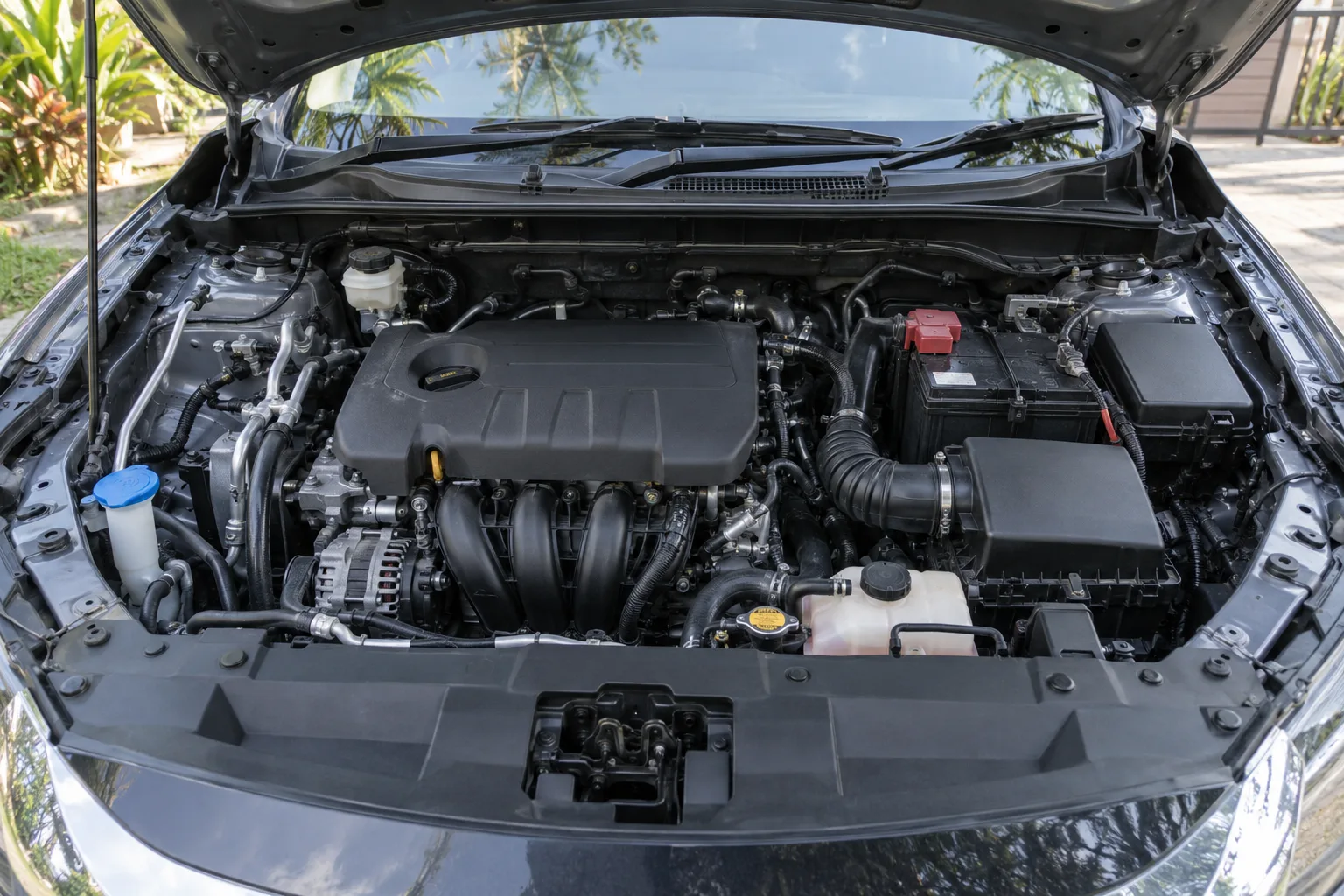
AI-generated illustration. No component has been diagnosed, removed or replaced in this image.
When might the starter be the issue?
The starter is worth investigating when the engine does not crank or cranks abnormally after the battery and its connections have been checked. A click is sometimes associated with starter trouble, but it can also occur when the electrical supply is insufficient. DENSO’s starter-system diagnosis and troubleshooting chart call for circuit checks rather than diagnosing by sound alone.
Describe whether you hear no sound, one click, repeated clicks, a slow engine turn, or a normal engine turn that never becomes running. These observations place the complaint in the right part of the sequence. A starter repair is not the automatic answer when the engine turns normally. If the fault occurs intermittently, note the conditions: engine warm or cold, after a short stop, or after several days parked. Do not continue repeated start attempts if there is a burning smell, smoke or unusual mechanical sound.
The service procedure for a starter can depend on access, vehicle model and what the tests find. Pungbrother’s alternator and starter repair service does not publish a fixed price, because a firm quote follows inspection. That is more honest than attaching one number to every model and every possible starting-circuit fault.
What order of tests avoids buying the wrong part?
Begin with the symptom and history. Was there a no-crank, slow-crank or charging warning? Did the vehicle previously need a jump? Then have the battery visually inspected and tested under the applicable specification, including cable and ground condition. If it is discharged, the reason for discharge should be considered. DENSO’s battery and starter guidance supports visual and performance checks before replacing components.
Next, test the circuit linked to the actual complaint. For a no-crank, that may mean starting-system checks. For a persistent charging warning, it means a charging-system assessment after the battery and connections are understood. The order can change with a model-specific warning or an obvious safety issue. This article cannot provide universal voltage thresholds or a parts verdict without the vehicle and its procedure.
Ask the workshop to explain three things in plain language: what was observed, what test separated one possible cause from another, and exactly which work the quote covers. An intermittent fault may not reproduce during one visit. In that case, a test report and a plan for gathering evidence are preferable to replacing the most expensive possible part on a guess.
What does Pungbrother charge for a starting-system complaint?
If the cause is not known, Pungbrother’s car diagnostic inspection lists guide prices of RM 80 for a small car and RM 120 for a large car, with around one hour shown as an estimated duration. This is an inspection guide price, not a promise to repair any starting problem for that amount.
When battery replacement is confirmed and agreed, the battery replacement page shows guide prices of RM 250 and RM 350 respectively and around 30 minutes estimated. There is no verified fixed price in the site’s data for every alternator, starter or wiring job. Pungbrother’s pricing page says estimates are followed by a firm quote before work. Ask for the findings and included work before approving a repair.
For a car in Masai, Johor, give the contact team the model, year, start symptom, any warning message and whether the car is safe to move. Do not assume roadside assistance or towing is included; ask what can be arranged if the car cannot reach the workshop.
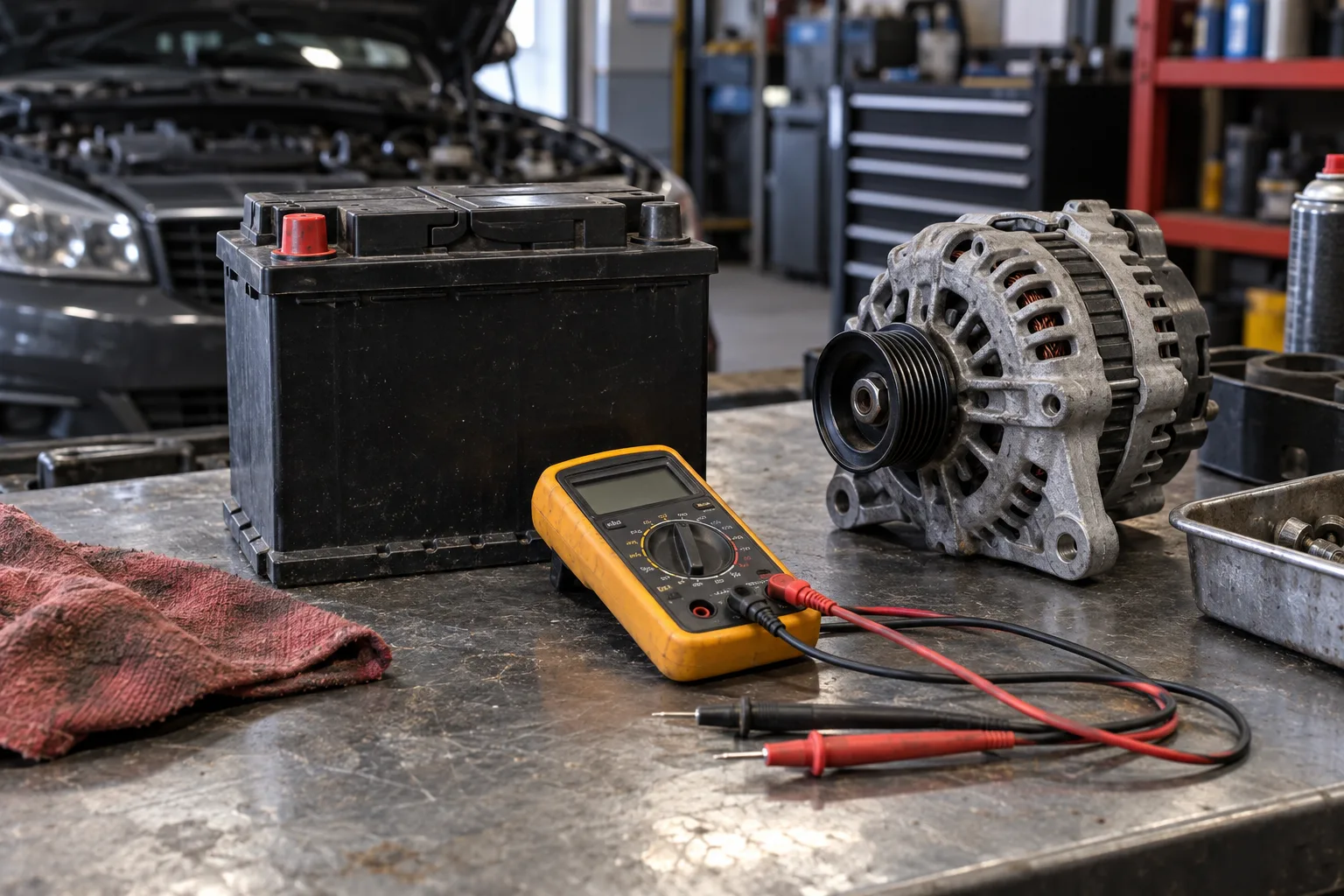
AI-generated illustration. Its equipment displays no test reading and makes no claim about a particular vehicle.
Frequently asked questions
If the car starts with a jump, is the starter definitely good?
No. The jump shows external power helped on that occasion. A starter fault may still be intermittent, and battery or connection problems may also be present. A technician should test the system that matches the complaint.
If a new battery goes flat, is the alternator definitely bad?
No. Charging, cable and electrical-draw issues are possibilities. DENSO recommends checking the battery and connections as part of charging-system diagnosis. Ask for test evidence before replacing an alternator.
Can bright headlights rule out a battery problem?
No. Headlight operation alone does not test whether the battery and cables can meet the starting system’s demands. Record what happens when starting and request a proper battery and circuit assessment.
Does one click mean the starter must be replaced?
No. A click is a description, not a diagnosis. Battery supply, connections and starter circuitry can overlap. The next useful step is inspection and relevant testing.
Why does the battery warning light matter while driving?
A persistent charging-related warning during running points to a system that needs prompt attention. It does not identify the alternator alone. Follow the response in your vehicle manual and arrange inspection.
What if the engine cranks normally but never starts?
Tell the workshop exactly that. The starter has turned the engine, so a battery or starter replacement should not be presumed from the phrase “won’t start.” The vehicle needs model-specific diagnosis of the running complaint.