A useful car service starts with your vehicle’s own maintenance schedule and your current symptoms. Tell the workshop what you want checked, ask what is included in the quoted job, and confirm any extra work before it begins. An oil-and-filter change is not automatically a full brake, tyre, battery and cooling-system inspection.
In short
- Check the service interval and specifications in your exact owner’s manual, not a generic kilometre rule copied from another model.
- Before booking, note warning lights, noises, leaks and any change in braking, steering or temperature.
- Ask for a written scope: fluids, filters, inspection items, parts, labour and what is excluded.
- Treat safety findings separately from optional work; request the evidence and a firm quote before approval.
- Pungbrother’s oil and filter change has published estimates from RM100 for small cars and RM150 for large cars. That price is not a promise that every checklist item below is included.
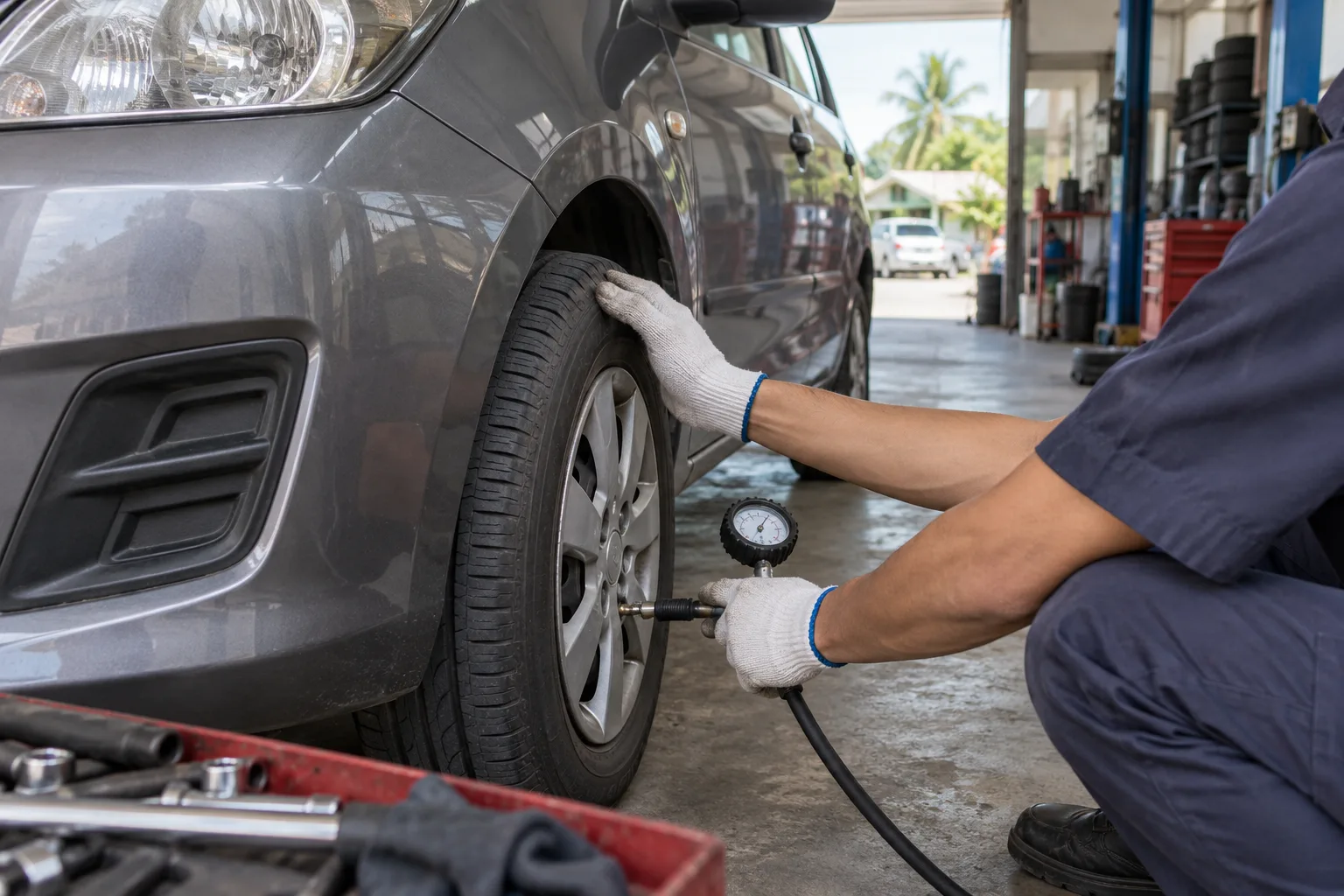
AI-generated illustration. It is not a photograph of a Pungbrother inspection.
What should you prepare before booking a car service?
Start with the exact vehicle, model year and service history. The owner’s manual or manufacturer maintenance schedule tells you when particular items are due and which fluids or parts are specified. Toyota’s maintenance schedule tool is an example of a maker tying intervals to the vehicle rather than publishing one rule for every car. Its market and model details may not match your Malaysian vehicle, so use the handbook supplied for yours.
Write down the current odometer reading and the date or mileage of the last relevant work if known. Bring prior invoices, especially if a fault has persisted. Tell the workshop about a steady or flashing warning light, overheating, a fluid leak, a weak start, uneven tyre wear or a change in braking. Do not wait for the technician to discover the symptom during a routine oil change. A service appointment can include scheduled maintenance and a separate diagnosis, but they are different tasks and may have different costs.
If you are preparing for a long drive, mention that and allow time for any necessary repair rather than booking only a quick change on departure day. If the car is unsafe to drive, ask for advice about recovery instead of bringing it in under its own power. The checklist helps you frame the conversation, not declare the car roadworthy.
Which checks belong on a general service discussion?
The exact checklist depends on the vehicle, mileage, symptoms and service package. Toyota’s general-maintenance guidance includes items such as engine oil, brake fluid, tyres and other visible conditions for the cited model. A workshop may also discuss coolant, battery, lights, wipers, filters and leaks. This is a menu of possible checks, not a claim that Pungbrother performs all of them in every quoted service.
Ask the workshop to mark three categories: work due under the maker’s schedule, inspection prompted by your symptoms, and optional work you may choose. That separation prevents an oil-and-filter job from quietly becoming a major service. A technician may identify a safety issue during a basic visit, but should explain the finding and obtain approval before extra paid work. Conversely, a basic service cannot guarantee that an unrequested fault was examined comprehensively.
For a specific service, ask what will be replaced and what will only be visually checked. “Check brakes” might mean a quick external observation or a more detailed wheel-off inspection; those are not identical. “Check battery” might mean looking at terminals or carrying out a performance test. Clear language makes quotes comparable.
How do you check oil and fluid work on a quote?
For an oil change, confirm the oil specification, quantity and filter suitable for your car, and ask whether disposal and labour are included. The vehicle maker’s requirements should guide the product choice. A cheap package that uses the wrong specification is not a bargain. After service, check that the invoice names what was used. If a leak or low level was found, ask whether the cause was diagnosed or only noted.
Other fluids require their own procedure. Brake fluid, coolant, transmission fluid and power-steering fluid are not interchangeable, and not every car uses every system. Do not approve a generic “all fluids” flush without knowing which fluids are due or why. The cooling system can be hot and pressurised; do not open a radiator cap as part of a driveway checklist. Our guide to coolant versus water explains why the exact fluid matters.
Pungbrother’s oil and filter service page describes oil and filter replacement with a basic leak check. Its pricing page lists RM100 and RM150 estimates by car size, with about 30 minutes as an estimate. Do not infer that brake pads, battery replacement or a full multi-point inspection is included in that amount. Ask before booking if you want additional checks.
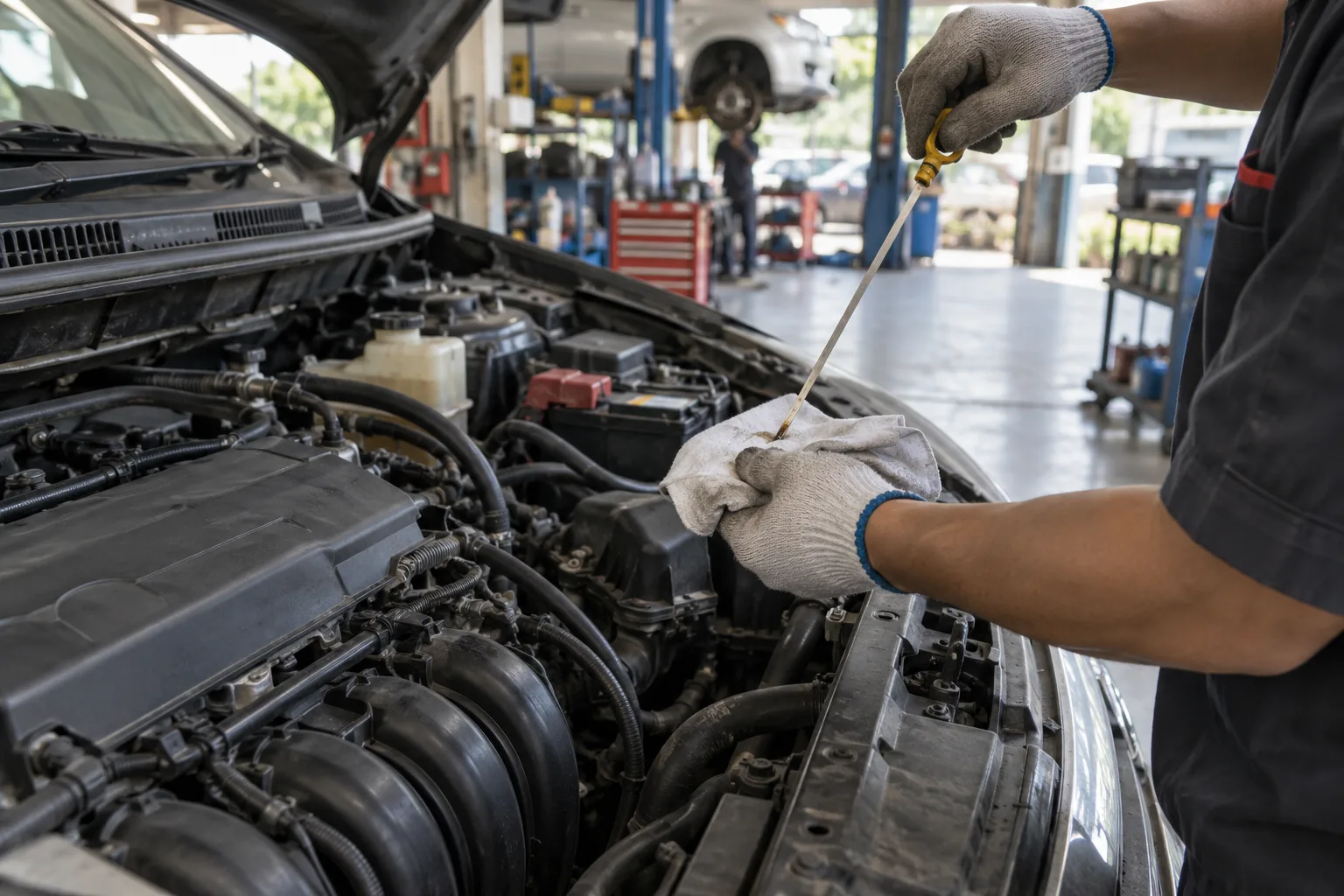
AI-generated illustration. Use the actual vehicle procedure for oil-level checks.
What should you ask about tyres, brakes and suspension?
Tyres affect the result of almost every road test. Ask whether pressure, condition, tread and uneven wear are part of the agreed inspection. The correct tyre pressure is vehicle-specific; use the vehicle label or manual. A wear pattern can point to alignment or suspension trouble but does not by itself identify a part. If you notice a pull or vibration, tell the workshop when it happens. A vibration only while braking leads to a different set of questions than a vibration at a constant speed.
Brakes deserve a precise scope. Ask whether pad thickness, disc condition, visible leaks and pedal feel will be checked, and whether any wheel removal is included. Toyota’s model-specific maintenance log lists brake inspection items, illustrating that inspection is an explicit task. A squeal is not always a pad replacement order, and a soft pedal may need prompt safety attention. Pungbrother has separate brake pad replacement and brake disc service pages; discuss the finding before approving either.
If the car bounces, clunks or wears tyres unevenly, ask for a suspension inspection rather than assuming an oil service covers it. If a tyre appears damaged or braking feels unreliable, tell the workshop before driving farther. A generic checklist is not a safety clearance.
| Area | What to ask the workshop | What to verify afterward |
|---|---|---|
| Oil and filter | Correct specification and included parts | Invoice names oil and filter used |
| Tyres | Pressure, wear, damage and scope of check | Finding recorded, not just “OK” |
| Brakes | Visual or wheel-off inspection? | Any repair quoted separately |
| Battery | Visual check or performance test? | Result and next action explained |
| Coolant | Level/condition and leak concern | Correct fluid and fault status noted |
| Warning lights | Diagnostic appointment required? | Codes and findings not confused |
How should you handle battery and warning-light findings?
If the car starts slowly or has needed jump starts, say so before the service. A visual glance at a battery is not the same as a proper performance test. A weak battery, poor terminal connection and charging-system fault can overlap in symptoms. DENSO’s charging-system diagnosis guidance begins with battery and connection checks before blaming an alternator. Ask what was measured and whether the battery or charging system actually failed.
A dashboard warning should not be buried under the phrase “routine service.” A check engine light may need diagnostic inspection; an oil-pressure, charging or temperature warning can have different urgency under the car’s manual. Describe the exact icon and when it appeared. If the warning is flashing or the vehicle runs badly, seek advice before using it normally. Do not request that a warning be cleared merely to make the dashboard look tidy.
If the technician finds a fault, ask for the symptom, test result, recommended remedy and whether it is necessary before further driving. A warning-code printout is useful context, but it is not always a completed diagnosis. A service invoice should distinguish scheduled maintenance completed today from a fault that remains under investigation.
How can you compare a car service quote fairly?
Compare the actual scope, not just the package name. Two “minor services” may use different oil, filters, inspection depth and labour assumptions. Ask whether the price includes tax, parts, labour, disposal and any diagnostic fee. If there are possible extras, ask which findings would trigger them and whether you will be asked before work proceeds. Pungbrother’s pricing page labels its five listed prices as estimates and promises a firm quote before work; that principle is particularly important for extra repairs.
Avoid agreeing to every suggested item on the spot if the reason is unclear. Ask which is required by the vehicle schedule, which is needed for safety and which is optional. For a replacement, request the part type and specification. For a fluid change, request the correct fluid and reason. For a diagnostic test, ask what question the test is meant to answer. This is not about distrusting a workshop; it creates a shared record of what you are paying for.
Before leaving, confirm what was completed, what was not, the next service date or mileage according to the vehicle schedule, and any warning that still needs attention. Keep the invoice. If a new sound or leak appears after service, contact the workshop with the invoice and a precise description rather than assuming its cause.
What can Pungbrother do for a service in Masai?
Pungbrother Enterprise is at 1, Jalan Kota 1/1, Cahaya Kota Puteri, 81750 Masai, Johor. The site lists an engine oil and filter change, battery replacement, brake service and diagnostic inspection among its services. Availability, correct parts and exact scope should be confirmed for your car before work.
Use the Pungbrother contact details to give the model, year, current mileage, required maintenance and any symptom. Ask for a firm quote that separates scheduled service from diagnosis or repair. If you want a full checklist inspection, say so explicitly; do not assume it comes with the published oil-change estimate. A short, accurate booking request often saves more time than a vague request for “full service.”
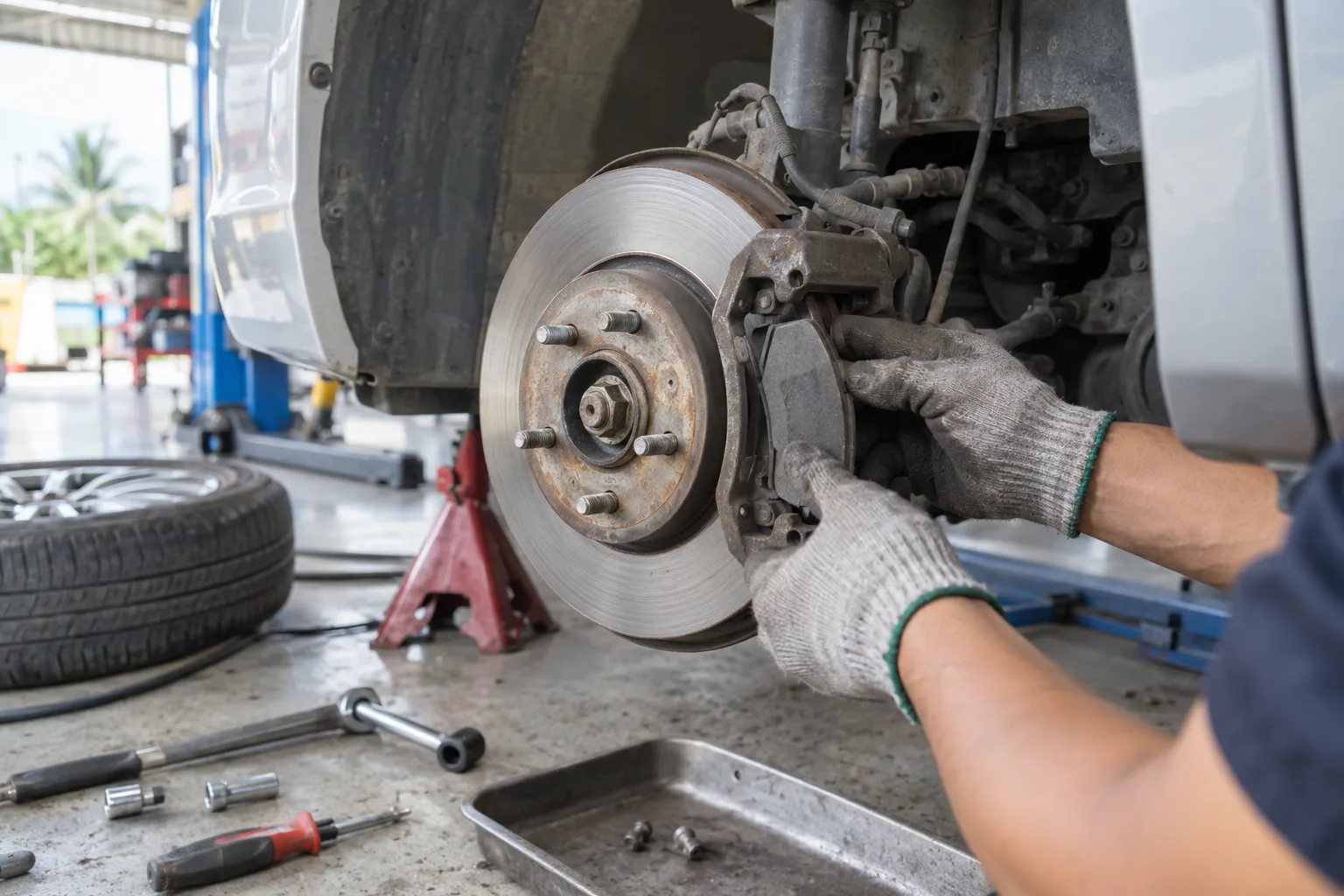
AI-generated illustration, not a confirmed vehicle condition or completed Pungbrother service.
Frequently asked questions
Is an oil change the same as a full car service?
No. An oil-and-filter change has a specific scope. A broader service may include scheduled replacements and inspections, depending on the car and quote. Confirm what is included before booking.
How often should I service my car in Malaysia?
Use the maintenance schedule for your exact model, engine and operating conditions. Do not substitute a universal kilometre rule or another market’s schedule without checking the local manual.
Should I approve repairs found during a routine service?
Ask for the finding, its urgency, the proposed parts and a firm quote. If it is a safety issue, discuss whether the car can be driven before the work is done.
Does a basic service include a battery test?
Not necessarily. A visual check and performance test are different tasks. Tell the workshop about weak starting and ask whether a test is included or separately quoted.
What is Pungbrother’s oil-change estimate?
Its pricing page lists RM100 for small cars and RM150 for large cars, with an approximate duration of 30 minutes. A firm quote follows before work.
What should I keep after a car service?
Keep the invoice, parts and fluid specification where listed, inspection findings, any unresolved warning and the next due maintenance according to the vehicle schedule. This record helps future diagnosis.