Plain water should not replace the coolant specified for routine use in your car. The correct fluid is chosen for the vehicle’s cooling system, not simply because Johor weather is warm. Use the coolant type and mixture in your owner’s manual. If the level has fallen, find out why before treating a top-up as a complete repair.
In short
- For routine use, follow the exact vehicle maker’s coolant specification and mixture. Toyota’s coolant guidance says not to use plain water alone for that model.
- A cooling system protects more than temperature alone; the specified fluid can also provide corrosion protection and lubrication for compatible components.
- Never remove a hot radiator or pressurised reservoir cap. Coolant and steam can burn you.
- An emergency top-up is not a universal water rule. Follow the exact manual and qualified advice for your vehicle, only after the system is safe to approach.
- Repeated low coolant or an overheating warning needs inspection. Pungbrother’s engine service is quoted after the fault is identified.
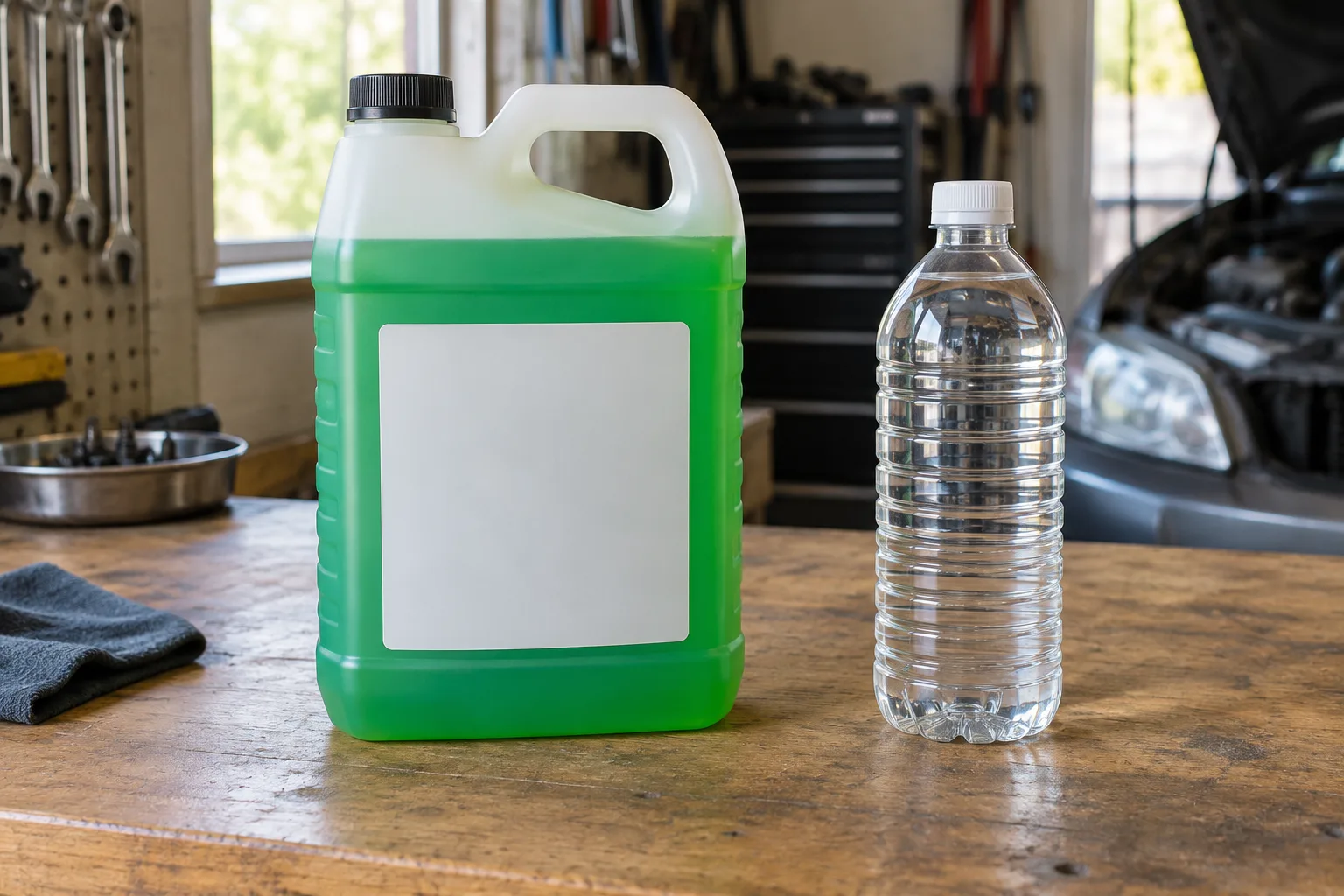
AI-generated illustration. Neither vessel represents a verified product or recommended mixture.
What is the difference between coolant and water?
Water transfers heat, but automotive coolant is a specified fluid or mixture designed for the whole cooling system. Depending on the vehicle, coolant formulation provides corrosion protection and helps protect components such as the water pump while meeting the maker’s temperature requirements. Toyota’s model guidance describes a proper coolant mixture and warns against using plain water or straight antifreeze alone. That instruction is not a universal recipe for every car; it illustrates why the exact specification matters.
Some products are supplied premixed, while concentrates need preparation in the required proportion. The colour of a fluid is not a reliable way to establish compatibility. Do not choose coolant by matching a photo or by assuming that every red, green or blue bottle means the same chemistry. Check the owner manual, service information or product approval for your model. If the history is unknown and the system already contains an unidentified fluid, ask a workshop before mixing products.
The word “radiator water” is common in everyday conversation, but it can hide an important distinction. Ask what fluid was actually put in the car, what specification it meets and whether it was diluted correctly. A workshop should be able to explain that without claiming that plain water is always harmless in a hot climate.
Does Malaysia’s climate make plain water acceptable?
No automatic exception follows from warm weather. A car’s cooling system has metals, seals and passages that need the fluid specified by its manufacturer. Even if freezing is not a local concern, corrosion protection and component compatibility remain relevant. Toyota explicitly says plain water alone is unsuitable for the cited Highlander. Other models may have different specified products, but the lesson is to use the exact vehicle requirements.
Do not use local climate to infer a universal concentration either. A vehicle manual may specify a premix or a particular dilution, and product labels may state that a bottle is concentrate rather than ready to pour. Too much or too little of a component can make the mixture unsuitable. If you do not know what is currently in the system, a service inspection is more reliable than adding a random bottle to the reservoir.
The same caution applies to long-distance driving. A car that has lost coolant repeatedly needs the leak or fault diagnosed before a highway trip. New fluid in the tank can temporarily hide a problem while the level falls again. Our overheating guide explains what to do if a temperature warning appears during the trip.
Can you add water in an emergency?
Treat this as a vehicle-specific exception, not a recommendation for routine maintenance. Some owner manuals may give an emergency procedure, while others prohibit water or require a specific fluid for that system. Check the manual for your exact model and follow qualified advice. Do not generalise from another car’s instructions. If you cannot confirm the procedure, or the vehicle is overheating or leaking, ask for roadside assistance or recovery instead of guessing.
The safety rule is firm: do not open a hot radiator or pressurised cap. Toyota’s engine-compartment safety guidance warns about pressurised hot coolant and fans that can start unexpectedly. Park safely, switch off as directed by the vehicle manual and allow the system to cool. Do not pour cold fluid into an overheated engine based on an article. If steam is escaping, stay clear of the bonnet until it is safe.
If an emergency top-up is permitted by your manual and performed safely, it does not settle the cause of coolant loss. The correct follow-up is to find the leak or other fault and restore the specified fluid in the correct condition. Tell the workshop exactly what you added, how much you added and whether the temperature warning returned.
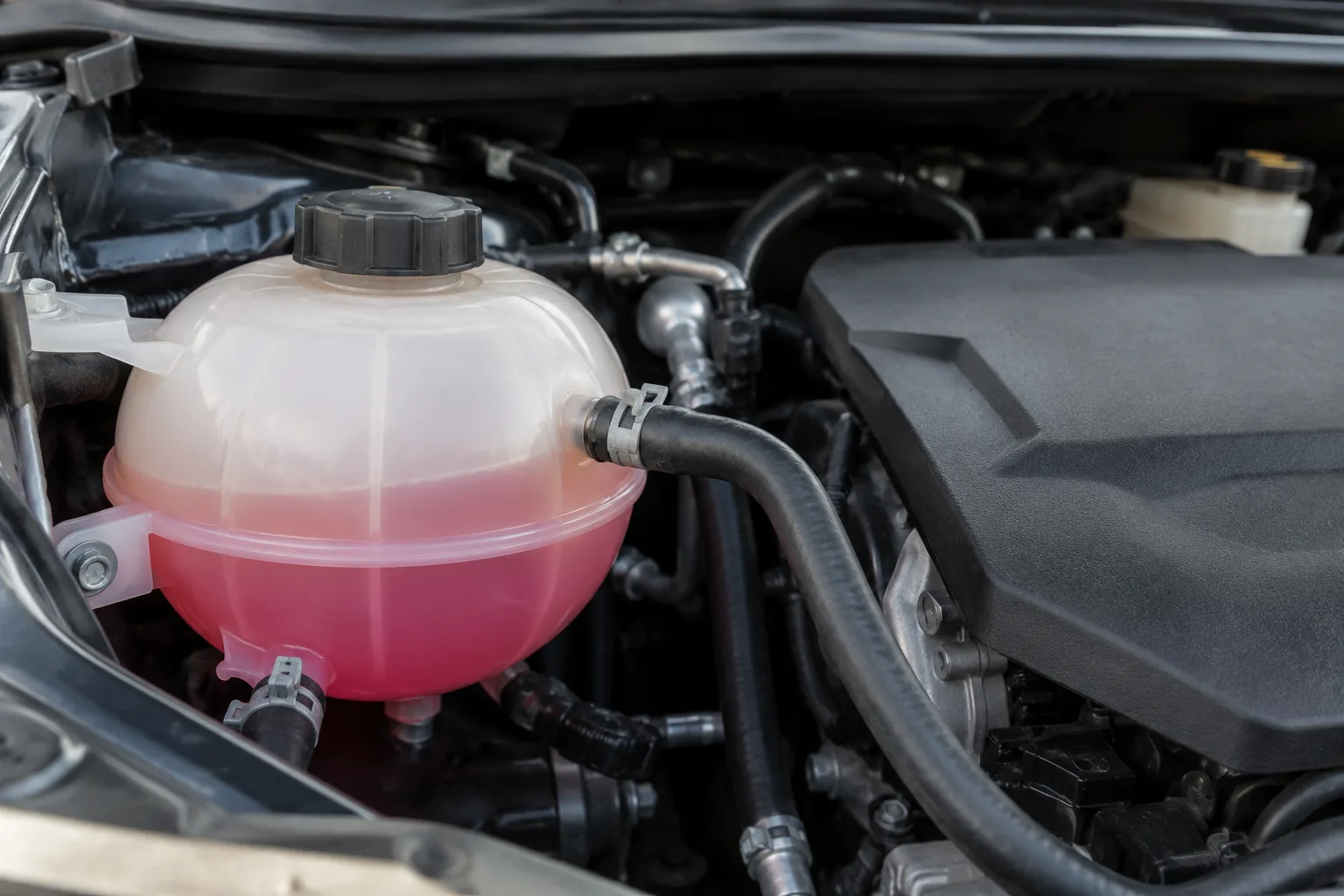
AI-generated illustration. Reservoir design and warning markings vary by vehicle.
How can you tell whether the coolant level is low?
Many vehicles have a marked expansion reservoir that can be observed when the engine is cool. The markings and procedure vary. Read your manual before checking; do not assume a low-looking hot tank is a low system level. The fluid expands when warm, and some tanks are pressurised. If the reservoir is opaque, the markings are unclear or access is unsafe, leave the check to a workshop.
If the level is below the correct mark when checked according to the manual, note whether it has dropped before. Watch for a temperature warning, a fresh puddle where the car parks, or visible dampness around hoses if you can observe safely without touching hot or moving parts. A low level does not reveal the location of a leak. A puddle may also be normal aircond water, engine oil or another fluid. Do not identify unknown fluid by touching or tasting it.
Ask a technician to determine whether there is a leak, an incorrect fill level or another cooling-system problem. A controlled inspection can locate the source and assess the condition of hoses, connections and other relevant parts. Adding coolant every few days without finding the reason is not a sound maintenance plan.
| Situation | Sensible next step | Avoid assuming |
|---|---|---|
| Normal scheduled service | Use exact coolant specification and mixture | Plain water is sufficient in Johor |
| Low level in a cooled reservoir | Note the level and ask why it fell | Any top-up fixes the underlying fault |
| Temperature warning or steam | Stop safely and follow owner manual | Opening the cap will help quickly |
| Unknown fluid already in system | Ask for vehicle-specific advice | Matching colour means compatibility |
| Emergency without correct fluid | Check the exact manual and seek qualified help | Water is universally approved |
Do coolant colour and service interval tell you what to buy?
Colour alone does not establish the chemistry or approval required by your car. A green, red or blue liquid may be dyed differently by different manufacturers. The manual and product specification are more reliable than colour matching. Similarly, a universal “change coolant every two years” rule may not fit a specific model. Maintenance intervals and procedures vary with the vehicle and fluid. Ask the workshop to show the schedule that applies to your car rather than accepting a date borrowed from another model or market.
If you are buying fluid yourself, distinguish premixed coolant from concentrate. A premix is intended to be used as supplied for the stated vehicle applications; a concentrate requires preparation to the specified ratio with suitable water. Never infer that a 100% concentrate is better because it seems stronger. Toyota’s guidance warns against straight antifreeze as well as plain water for the cited model.
If a service centre offers a flush, ask why it is needed, what fluid will replace the existing one, whether the system has a leak and how air will be removed according to the vehicle procedure. This is more useful than approving a generic “radiator treatment” without knowing what the car requires.
When should a workshop inspect the cooling system?
Arrange inspection if the coolant level repeatedly falls, the car overheats, the heater behaves unexpectedly, a hose or reservoir appears damaged, or you do not know whether the correct fluid is present. A new puddle and a returning temperature warning call for prompt advice; if the car may overheat again, ask whether it should be recovered rather than driven. The workshop should identify the actual fault before recommending a radiator, pump, hose or other replacement.
Pungbrother Enterprise in Masai, Johor, has an engine repair and overhaul service and a diagnostic inspection service. These pages do not promise that every cooling fault is electronic or has a fixed price. Pungbrother’s pricing page lists confirmed estimates only for five specified services and says a firm quote comes before agreed work. Request a cooling-system finding and itemised quote rather than assuming a price from a different service.
Describe the vehicle model, year, warning, any fluid you added, and the pattern of loss. The workshop is at 1, Jalan Kota 1/1, Cahaya Kota Puteri, 81750 Masai, Johor. Use the workshop contact page for current contact details and to ask whether the car is safe to bring in.
AI-generated illustration. Always check the real manual and actual product label.
Frequently asked questions
Can I use tap water instead of coolant in Malaysia?
Not for routine use unless your exact vehicle maker explicitly specifies it. Use the coolant type and mixture stated in your owner’s manual. Warm weather does not remove corrosion and compatibility requirements.
Can I top up the coolant while the engine is hot?
Do not open a hot radiator or pressurised reservoir cap. Hot coolant and steam can cause burns. Follow the vehicle maker’s cooling and inspection procedure or ask a professional.
Is coolant colour enough to identify the right type?
No. Dye colour is not a reliable compatibility test. Check the fluid specification for your vehicle and the product approval, especially if the existing fluid is unknown.
If I top up once, do I still need a leak check?
If the level had fallen, you should understand why, particularly if it falls again or a warning appears. A top-up restores level temporarily but does not repair a leak or circulation fault.
Does a small puddle always mean coolant is leaking?
No. Aircond condensation and other fluids can also collect beneath a parked car. A technician should identify the fluid and source before quoting a cooling-system part.
Does Pungbrother list a fixed coolant repair price?
No universal cooling-system repair price is confirmed on its pricing page. Ask for inspection findings and a firm quote before work.