Brake Disc and Rotor Service
Brake discs, rotors and pad contact surfaces are inspected for safe repair recommendations.
How pads, rotors, tyres and suspension can contribute to vibration.
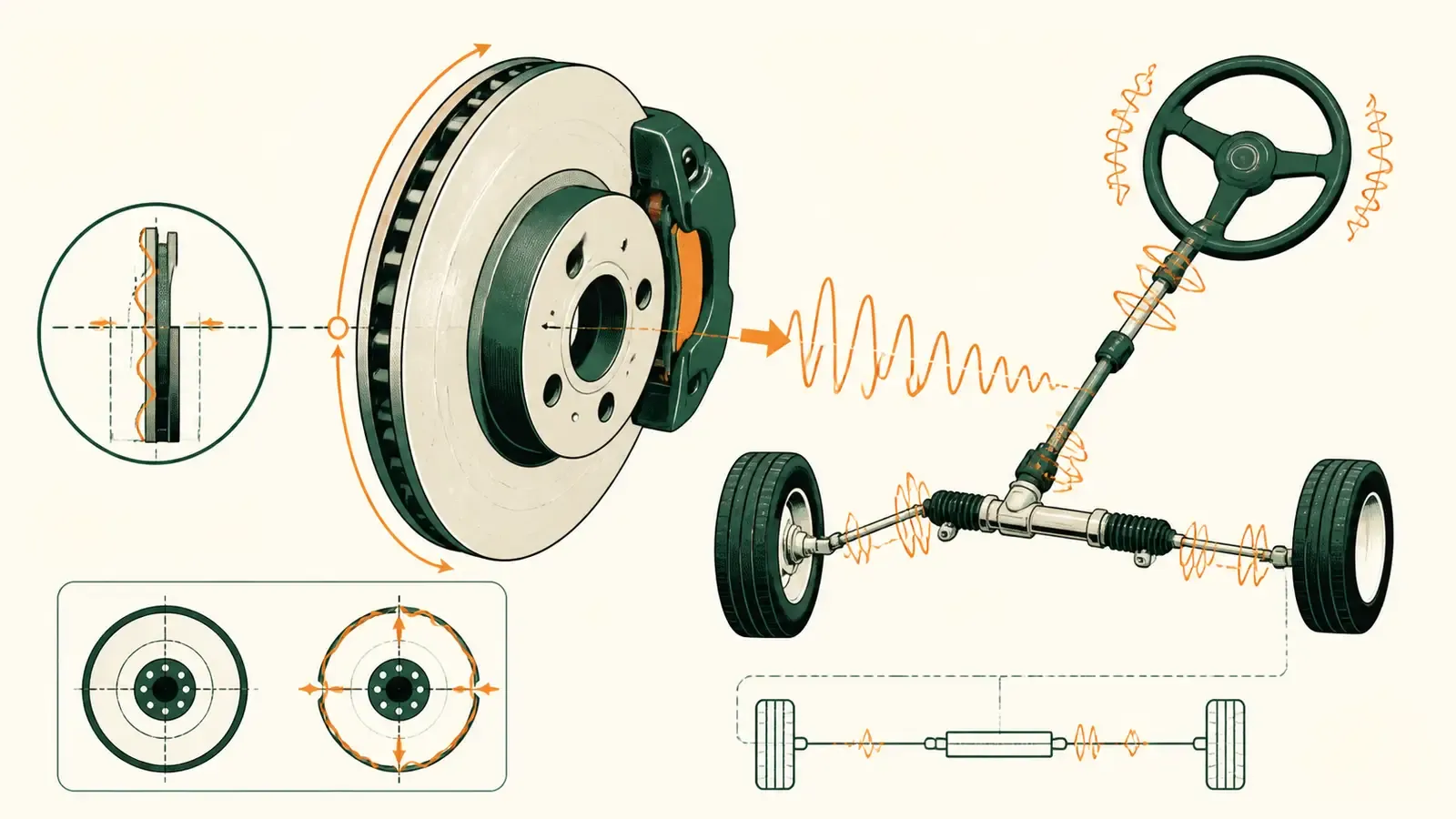
A shake felt through the steering wheel, but not through the seat or the whole car, almost always points to the front brake rotors. As each wheel turns, a high spot or an uneven rotor surface pushes the caliper piston in and out, and that back-and-forth motion travels straight up the steering column into your hands. It usually gets worse the harder you brake, and is barely noticeable on a light touch of the pedal. If the shake is felt through the pedal itself, or through the seat and floor rather than the wheel, the cause is more likely somewhere else — the rear brakes, a tyre out of balance, or a suspension component moving under load. Working out where the vibration is felt first narrows down whether the fix is a brake job or something else entirely, and the parts and price are very different.
Yes — an uneven rotor is the single most common reason for a pulsing pedal or a shaking wheel under braking. Rotors wear thin over thousands of stops, and heat from hard or repeated braking can cause them to warp slightly or develop a hard, glazed spot where a pad has been dragging unevenly. Once the disc surface is no longer flat, the pad grips and releases with every rotation instead of gripping smoothly, and that pulsing is what you feel. Scoring — thin grooves cut into the disc, usually by a worn-out pad down to bare metal — has the same effect. A Brake Disc and Rotor Service measures disc thickness and run-out on a gauge rather than by feel, and the workshop tells you whether the disc can be resurfaced or needs replacing before quoting the job.
Pads on their own rarely cause a shake, but they are almost always checked at the same time because a badly worn pad is often what damaged the rotor in the first place. Once a pad wears down to its metal backing plate, that metal drags directly against the rotor surface every time you brake, cutting grooves into it within a short distance. If the pads are close to the wear limit when the rotor problem is found, replacing both together avoids paying labour twice, since the caliper has to come off either way. Brake Pad Replacement takes about an hour and costs RM 200 for a small car or RM 250 for a large one, and pad thickness is checked as a normal part of any brake inspection.
A shake that shows up mainly when you brake, especially alongside a clunk over bumps, a car that pulls to one side, or a steering wheel that feels loose, points toward suspension wear rather than the brakes themselves. Bushes, ball joints and shock absorbers all keep the wheel steady under load, and when they wear out, braking force lets the wheel move slightly instead of staying planted. That movement can feel a lot like a warped rotor from the driver's seat, which is why guessing based on feel alone is unreliable. Symptoms of Worn Car Suspension sets out the noises and handling changes to watch for, and checking them against what you're feeling is a useful step before booking a rotor job that may not fix anything.
Uneven tyre wear or a wheel that has lost its balance can also produce a shake close to a warped rotor, particularly above around 80 km/h on the highway. Misalignment loads one side of the suspension more heavily than the other, wearing bushes and tyres faster and sometimes making braking feel uneven even when the discs themselves are fine. A quick visual check of tyre wear patterns during a brake inspection is usually enough to tell whether the vibration comes from the wheel and tyre assembly or from the braking system, and it costs nothing extra to look while the car is already up on the hoist.
Rotor thickness, pad wear and tyre condition are all items a routine service should already cover, which is why catching this kind of shake early is usually cheaper than waiting for the pedal to start pulsing badly. The Car Service Checklist sets out what to ask the workshop to look at during a normal visit, so nothing gets skipped because nobody thought to mention it. Choosing Engine Oil in Malaysia matters for a different reason — the wrong specification for your climate and mileage can shorten engine life — but it is worth confirming at the same visit since the car is already booked in and the oil is due to be checked anyway.
Once the car is up on the hoist for a brake check, it costs nothing to glance at a few other wear items while the mechanic is there. Signs of a Weak Car Battery often appear weeks or months before the battery actually fails — slow cranking, dim headlights at idle — and catching it early avoids being stranded in a car park. Aircond Compressor Failure Signs are easy to miss in daily driving until cooling drops noticeably in slow traffic. Mentioning either symptom when you book the brake inspection means the workshop can check them in the same visit instead of a second trip.
A mild shake that only shows up under hard braking from highway speed can usually wait until your next scheduled service, but one that is getting stronger week by week, or that now happens during ordinary city braking, is worth booking sooner rather than later. Rotor wear does not reverse itself, and a disc left too thin to resurface will need full replacement instead of a cheaper skim, which is the more expensive outcome if you wait too long.
If you cannot tell whether the cause is the rotors, the pads, the suspension or the tyres, a Car Diagnostic Inspection at RM 80 for a small car or RM 120 for a large one is the fastest way to find out before any parts are ordered. That is a smaller cost than replacing a rotor that turns out to be fine, or fitting new pads when the real fault is a worn suspension bush that keeps wearing the new parts the same way.
| Symptom | Likely Cause | Estimated Cost |
|---|---|---|
| Shake felt in steering wheel | Warped or scored rotor | varies — inspection needed |
| Shake felt in pedal or seat | Suspension component wear | varies — inspection needed |
| Shake plus pulling to one side | Alignment or suspension wear | varies — inspection needed |
| Pedal pulsation with thin pads | Pad replacement needed | RM 200–250 |
| Shake mainly at highway speed | Tyre imbalance | varies — inspection needed |
| Unsure of the cause | Diagnostic inspection | RM 80–120 |
Brake discs, rotors and pad contact surfaces are inspected for safe repair recommendations.
Brake pads and visible braking components are checked before replacement work begins.
Not always. A shake felt mainly through the steering wheel usually points to a warped or scored rotor, but the same sensation can come from a wheel out of balance, worn suspension bushes, or misaligned front wheels. A brake inspection checks the rotors first, since that is the most common cause, and rules other systems in or out from there.
Usually not on its own. Pads rarely cause the shake directly, but a badly worn pad can score the rotor surface, which is the actual source of the vibration. If the rotor is already scored or warped, new pads alone will not stop the shake — the disc needs measuring and, in many cases, resurfacing or replacement alongside the pads.
A Car Diagnostic Inspection costs RM 80 for a small car or RM 120 for a large one and takes about an hour. It covers the brakes, a visual suspension check and tyre condition, so you get a clear answer on which system is causing the shake before any parts are ordered or quoted.
A mild shake felt only under hard braking from higher speed can usually wait for your next scheduled service, but it is worth mentioning when you book so the rotors are checked. A shake that gets stronger week by week, or that starts happening during normal city braking, should be looked at sooner rather than later.
1, Jalan Kota 1/1, Cahaya Kota Puteri, 81750 Masai, Johor