Wheel Alignment and Balancing
Wheel alignment and balance concerns are checked together with visible tyre and suspension condition.
How wheel balance, alignment, tyres and brakes can cause vibration.
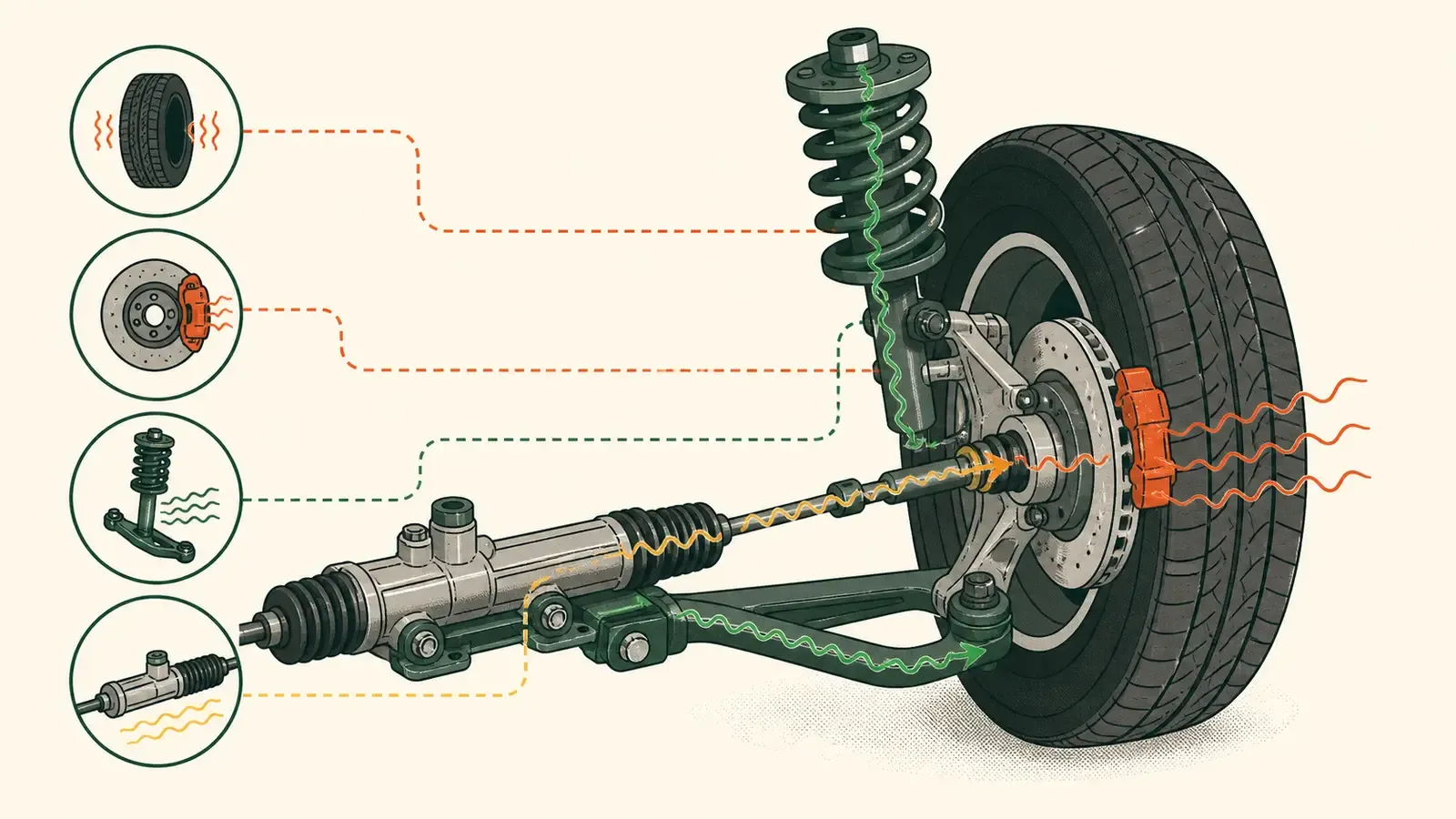
A vibrating steering wheel almost always comes down to one of four things: unbalanced wheels, a steering or suspension geometry that's out of alignment, tyres that are worn or damaged, or a brake component that's no longer perfectly round. Which one it is depends on when the vibration shows up — only at speed, only under braking, only over bumps, or constantly regardless of what the car is doing. On a Myvi or a Saga doing daily Johor traffic, the most common cause by far is a wheel that's picked up a small dent or lost a balance weight after hitting a pothole, but the same shake can also mean a rotor that's warped from heat or a suspension bush that's finally given up. A structured inspection that looks at wheel balance, alignment and visible suspension and tyre condition together is the only way to tell them apart before anything gets quoted, because guessing and replacing parts one at a time usually costs more than diagnosing it properly first.
Yes, and the speed at which it appears is the first useful clue for narrowing down the cause. A wheel that's out of balance typically vibrates hardest somewhere between 80 and 110 km/h and eases off above or below that range — that's the classic highway shudder. A steering wheel that pulls or feels off-centre at any speed, not just a narrow band, points to alignment rather than balance. Vibration that only shows up over bumps, expansion joints or rough patches, no matter how fast you're going, usually means a suspension component is worn rather than the wheels themselves being out of round. If you notice more than one of these patterns at once, more than one thing is probably going on, and it's worth describing all of them when you book the car in rather than just the loudest one.
Tyres can cause the exact same symptom as a balance problem, and it's easy to mix the two up. A tyre that's cupped, has a flat spot from hard braking, or has a bulge from impact damage will vibrate at speed in a way that rebalancing alone won't fix, because the tyre itself isn't round anymore rather than the wheel being unevenly weighted. Uneven wear across the tread — more worn on one edge than the other — is also a sign that alignment has been off for a while rather than a new fault. A quick visual check of tread wear pattern and sidewall condition is usually done as part of a balancing or alignment inspection anyway, so it's rarely a separate cost, but it does mean the fix might be a tyre replacement rather than a balance job.
If the shake only happens when you brake, not while cruising, the likely cause is a warped rotor or a pad wearing unevenly against the disc face — both change how smoothly the brake bites and send a pulse back through the pedal and steering wheel. Brake pad wear is also tied to driving style and how long the pads have already been in service, which is covered in more detail in How Long Do Brake Pads Last. If an ABS warning light comes on at the same time as the pedal pulsation, the cause may be electronic rather than purely mechanical wear, and that combination is worth reading up on in What Does the ABS Warning Light Mean before assuming a rotor skim or pad change will sort it out on its own.
Clunking over bumps, a car that visibly sits unevenly from side to side, or tyres wearing noticeably faster on one corner than the others point away from tyres and balance and toward a worn suspension part — a bush, a ball joint, or a shock absorber past its useful life. These parts don't put a warning light on the dashboard, so a physical inspection is the only reliable way to confirm which one has failed and whether the repair is a single component or several connected ones. Left long enough, a worn bush or joint also throws the alignment out again shortly after it's corrected, which is why the two jobs are often booked together rather than treated as competing fixes.
Wheel Alignment and Balancing looks at tyre condition, steering geometry and wheel balance as one job, because the three interact with each other. A car can be perfectly balanced and still pull to one side if the alignment is off, and it can vibrate at highway speed even with straight alignment if a single wheel has lost a balance weight. There's no fixed price for this service — it's quoted after the inspection because the scope depends on how far out the geometry has drifted, and whether the fix is a straightforward toe adjustment, a full four-wheel alignment, or rebalancing on top of that.
If the inspection turns up a worn bush, joint, or shock rather than just a geometry or balance issue, the job shifts from Wheel Alignment and Balancing to Suspension Repair. That service checks the shocks, struts, bushes and joints individually, and the quote reflects whichever parts are actually causing the clunk, pull or vibration rather than replacing everything as a set. It's common for a car to need both — a worn component gets replaced first, then the alignment is set once the new part is in, because aligning against worn suspension rarely holds for long.
A mild vibration that only shows up on the highway can usually wait a week or two for a convenient booking slot, but it won't correct itself, and the tyre wearing unevenly in the meantime only gets worse the longer it's left. A vibration that's getting noticeably stronger, that comes with a pull to one side, or that shows up specifically under braking is worth booking sooner, because that combination usually means more than one part is involved. Delaying a multi-part fault rarely makes it cheaper — it just gives the worn part time to wear something else next to it, which turns a single-item quote into a longer repair list later.
If the car is already booked in, it's a reasonable time to also run through How to Prepare Your Car for a Long Drive, particularly before a trip out of Johor. While the car is up for the alignment check, it costs nothing extra to glance at the engine bay for Signs of an Engine Oil Leak, since a leak found early is a smaller job than one found after it's dripped onto a belt or hose. If the aircond has been blowing warm on the same drives where the steering shakes, mention that too — Why Is My Car Aircond Not Cold covers what gets checked first, and bundling the two means one workshop visit instead of two separate ones.
Tell the workshop what speed the vibration appears at, whether it happens under braking, and whether the steering pulls to one side rather than just shaking straight — that alone narrows down whether the visit should start with alignment and balancing or go straight to a suspension check. Mentioning the model, roughly how many kilometres are on the current tyres, and how long the shake has been happening also helps decide whether a full inspection slot is needed or whether it's a quick rebalance that can be finished within the hour.
| Symptom | Likely cause | Estimated cost |
|---|---|---|
| Vibration only at highway speed (80–110 km/h) | Wheel out of balance | varies — inspection needed |
| Steering pulls or feels off-centre at any speed | Wheel alignment out | varies — inspection needed |
| Vibration only under braking | Warped brake rotor | varies — inspection needed |
| Squealing plus vibration, thin pad visible | Worn brake pads | RM 200 (small car) / RM 250 (large car) |
| Clunking over bumps, uneven tyre wear | Worn suspension component | varies — inspection needed |
Wheel alignment and balance concerns are checked together with visible tyre and suspension condition.
Suspension components are inspected to identify wear, noise and handling concerns.
A mild, occasional vibration at highway speed is rarely urgent on its own, but a vibration that's getting stronger, that comes with a pull to one side, or that appears under braking affects how the car handles and stops. Any combination like that is worth booking an inspection before a longer drive, rather than waiting to see if it worsens.
Yes. Tyres that are underinflated or unevenly inflated can flex differently at speed and create a vibration that looks like a balance problem. Checking and correcting pressure across all four tyres is a quick first step, but if the vibration continues once pressures are equal, the cause is more likely a wheel, alignment or suspension issue that needs an inspection.
There's no fixed price, because the job depends on how far the geometry has drifted and whether a wheel also needs rebalancing. The workshop checks tyre condition, alignment and balance together and provides a firm quote before starting, so you know the full cost before any work is approved.
Not on its own. New tyres remove tyre-related causes like cupping or a flat spot, but a worn bush, joint or shock will keep vibrating or clunking regardless of tyre condition. An inspection that checks suspension components alongside the tyres avoids paying for new tyres that don't actually solve the problem.
1, Jalan Kota 1/1, Cahaya Kota Puteri, 81750 Masai, Johor